


Recent Happenings
WIRED. Meta Now Lets Anyone Use Your Instagram Photos in AI Images—Unless You Opt Out
WIRED. What Happens if China Hacks the US Water Supply? I Went to a Secret War Game to Find Out.

“I used to be all about gas guzzlers like the Benz and Celsior when I was young. But these days, even Yakuza drive hybrids. Priuses are all the rage now.”
–– Ebihara Satoshi (The Fable)
Any bona fide anime enjoyer will know that the Yakuza have been in decline. The Yakuza of old were the ones who cultivated the look that we are still familiar to this day: full-body irezumi tattoos, flashy suits, baller haircuts, and black cars with tinted windows idling outside offices with the group’s name on a plaque by the door. They were accepted as a necessary evil ruling the underworld and its vices. Gambling dens, prostitution, loan sharking, protection rackets, and drugs. This glamorized criminal aristocracy has since dwindled. Today, the police count less than 20,000 members.

The 1992 Anti-Boryokudan Law marked the end of an era for Yakuza. The modern gangsters have been segregated to a life of survival and a public perception of disappointment. Their work has become perceivably more boring. Paperwork-heavy fraud. They pressure tenants or landowners to vacate property for redevelopment. They set up shell companies. They serve as unlicensed subcontractors, informal mediators, and loan guarantors. Rackets that are lowkey and under the radar; jobs that could be done in a more legitimate way but which are tedious and murky and could benefit from shortcuts.

Much of the modern digital underworld is organized similarly. We have been collectively sold this idea that the online criminal world is ruled by people with Guy Fawkes-style masks, black hoodies, and many green characters quickly moving on the screen. There is a clear moodboard cybercriminal aesthetics. Perhaps some such cases remain.

However, the vast majority of modern observable cybercriminal/illicit/shady offerings are amusingly boring––B2B SaaS style. But boring doesn’t mean it is not lucrative.
Today, I’m going to walk you through the top 5 most prevalent yet most boring shady offerings online.
#1 Getting people banned and unbanning solutions
One of the most valuable modern digital assets are social media accounts. Like some form of demanding electronic fruit tree, they require hard work and effort to grow (e.g., posting reels, interacting with accounts, etc.). Eventually, they bear fruit. Brands will pay you to make sponsored content, they will send you gifts, they will hire you as a consultant, etc. For many content creators, their social media account(s) are their lifeline. Therefore, there is a thriving underground economy dedicated to getting large accounts banned––think, for example, your competitors. Some common tricks include finding content in your profile that may be in violation of a platform’s guidelines and reporting you aggressively. Another one involves creating an account and claiming you impersonated them. ProPublica did a story on one such fraudster.
Of course, some of these same individuals who specialize in getting accounts banned also offer unbanning services. There is little information about how these work, only speculation. The top theories involve:
You have a plug at Meta/TikTok/X/whatever who has access to internal systems and can reverse decisions. This is not farfetched given that a lot of moderation roles are outsourced.
You have gotten really good at crafting appeals (e.g., using the right keywords) that trick automated moderation systems into escalating your ticket. This seems dumb until you realize that: Hackers Simply Asked Meta AI to Give Them Access to High-Profile Instagram Accounts.
You work with lawyers to send reversal requests to the target company. This might be particularly relevant depending on what triggered the ban.
Regardless of how these work, prices seem to range between three and four digits, often between $500-4000 per account.
#2 “Dark” PR Services
Imagine you are a totally legitimate cryptocurrency project/token/coin struggling to get traction. Prospective gamblers investors just don’t seem to be convinced of your team’s legitimacy.

Not to worry. For a modicum price you can buy a press feature at newspapers and magazines (some sellers even offer TV interviews), ranging from the barely reputable to the seemingly so. Yahoo Finance, NASDAQ.com, BBC.co.uk Hypebeast, WWD, Mashable, Forbes, Harper’s Bazaar Vietnam, and even the Milwaukee Journal Sentinel. Sellers also specialize in many other niches, such as nutritional supplements (e.g., protein shakes, herbal capsules, electrolytes, etc.). The way these work is by exploiting starving writers who have contributor rights to these publications and exploiting the public’s perception of legitimacy of these media outlets. There is nothing illegal about this, as far as I can tell. But damn, it feels greasy that you can just buy articles in these outlets.

Prices: Typically in the four digits, commonly ranging between $2,000 to $10,000 per press feature. Prices tend to be higher for articles that are not marked as sponsored, certain niches, and for having hyperlinks to your website.
#3 Reputation Repair: Content Removal and De-Indexing
Nasty things about you on the Internet can live on forever unless you do something about it. For example, let’s say you committed a crime (and you paid your dues to society). Or, let’s say people published nasty untrue things about you (a.k.a. libel). It would be unfair for that to always exist front and center when people search your name on Google. Usually, there’s legal recourse for you, especially if you deserve it. The Europeans, in particular, have done well by implementing something called the right to be forgotten. Many agencies/lawyers can help you with this stuff in a clean way.
Now, let’s say the law is not on your side. Or, you need to attack a competitor. There’s a vast network of resources for you in the underworld at your disposal. There are three types of services that online reputation management agencies will offer. Deindexing: remove the search result from a search engine, but the content remains. Source removal: getting the content itself taken down. Suppression: making positive results/content more salient than negative ones. Virtually any platform and type of content is available: reviews, posts, videos, articles, search results. Bad reviews on Yelp, Glassdoor, BBB, Google Reviews. Gone. People saying bad––yet true––things about you on Reddit, YouTube, or Instagram. Poof, done. eBay, Amazon? Ezpz.
We are able to Deindex Content on ANY WEBSITE, Or Forum, ANY Article, Reddit Posts, Review, Yelp Pages, BBB / bbb org pages, Glassdoor, Google Reviews, Wikipedia, Social Media Links, PDF’s, .Gov, .Edu, Archives, / Official Sites, Youtube Videos, Pictures, Post or ANY other content from Google, Bing and Yandex!
–– A listing in an online forum.
Mechanisms vary. One avenue is to weaponize legitimate processes, such as DMCA takedown requests (i.e., submitting an unwarranted copyright claim). The idea is that the receiving platform (e.g., Google) will err on the side of compliance and not spend too much time verifying the authenticity of the claim. Similarly, you can report the content that you want to take down as harassment or being fake. On some platforms, if you control enough accounts, you can mass report a piece of content and successfully get the content deleted. Lastly, similar to the unbanning case, an insider may also help you out, once again because moderation teams are often outsourced.
Prices: Mostly around three digits, ranging from $450 to $900 per removal, depending on the platform.
#4 Ranking Higher in Search Results and AI Answers
This is one of the most boring and the most ancient. The moment that search engines became a thing, the market for services that help you rank higher came into existence. Regardless of the platform, ranking higher is almost always a good thing. I’d prefer that, if you searched my name, you would get my homepage as a search result higher than the news of the guy who got arrested in connection with a murder. And, if you searched for this publication’s name, I would hope it would rank higher than the auto parts manufacturer. As with all things, there is a legitimate and illegitimate market for these things and the distinguishing factor is whether you play by the rules.
On Google, what makes your website rank higher in search results is having other high-ranking websites linking to you and having a lot of traffic. The name of the game is domain authority. This is why, for example, people pay for press pieces that link to them (see above). But there’s other sneaky and creative ways. If you remember my takedown scam piece, you would have seen that some people send fake DMCA notices in hopes that you link to their website (in the guise of copyright attribution). Other techniques involve: buying expired domains that have residual trust (from previous links that pointed to them), using bots to boost a website’s traffic, and buying links from content farms.
Google is by far the main target of these services, but sellers also offer other platforms like YouTube and Pinterest. Like all other things in the world, AI is not absent from the conversation. Not only is AI used to automate many of these services, but sellers also promise to boost your brand’s appearance within the recommendations that ChatGPT/Claude/Gemini give you when you search what are things to do in New York City. To achieve this, fraudsters seem to rely on injecting content in high-visibility places where AI agents may go searching for answers, like Quora and Reddit.
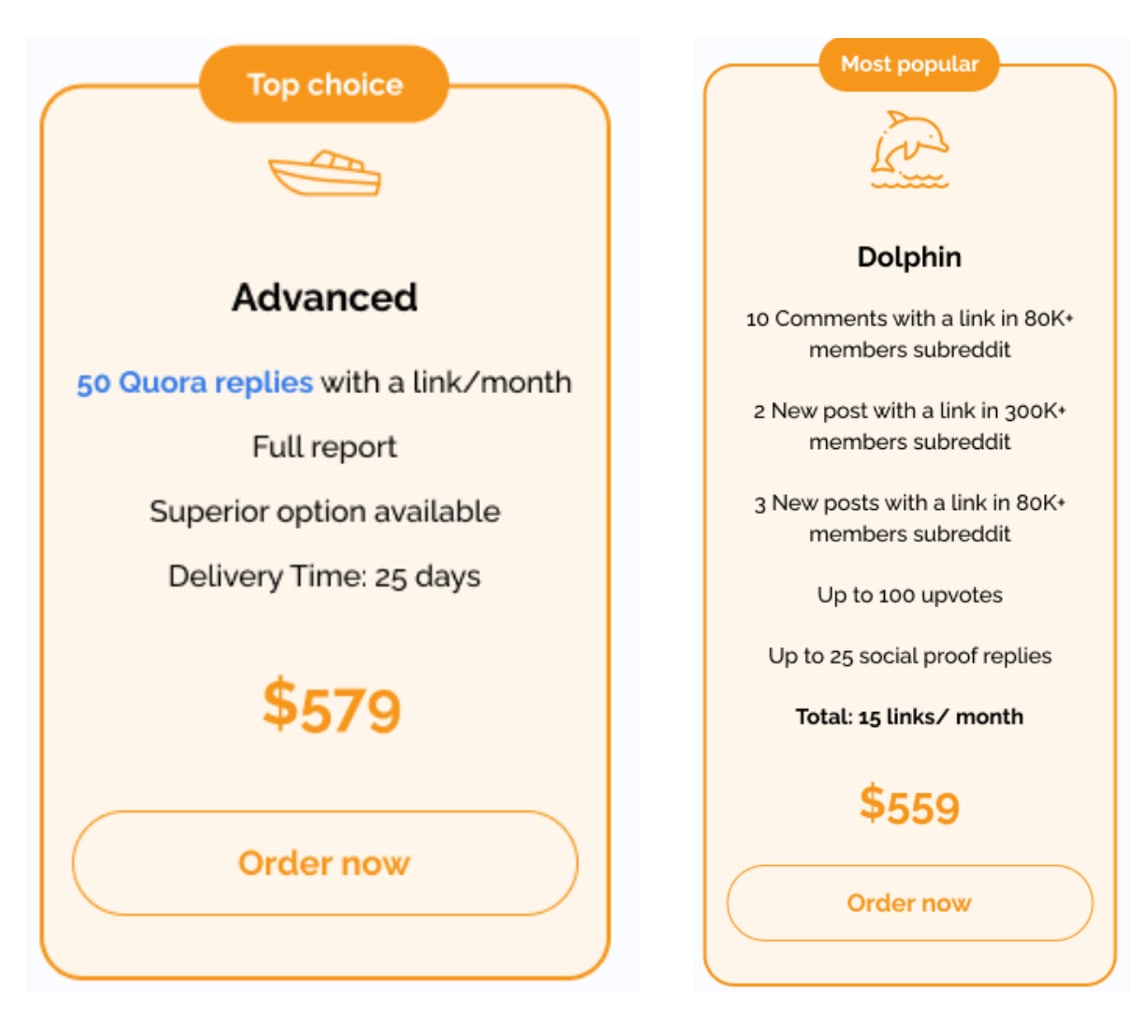
Prices: Ranking-related services range from 2 to 4 digits given the variety of offerings. A sample of what $500-ish bucks gets you is shown above.
#5 Trading Usernames
The dream of any teenager who spent their days playing online video games and shitposting on forums was to make a tremendous amount of money through some sort of esoteric knowledge that they acquired by being terminally online. At least this was my dream and this dream was weaved by the old heads who told tales of days before mine, where lucky Internet prospectors had registered the right domain names amidst the dotcom bubble. This is how I learned of this semi-mythical Paraguayan creature named Chris Chena, a whiz kid who had made a fortune buying domain names like: Juegos.com (games), Ajedrez.com (chess), Viajes.com (trips/travel), Computadoras.com (computers).
Unfortunately, by the time I was a teenager, the resale of domains was highly saturated. The gold rush was done, dominated by algorithmic snipers who would register any meaningful domain within milliseconds. But for many kids, this dream stayed alive as new platforms, like Instagram and Twitter, began rolling out usernames that behave like domain names. Today, owning the username @ajedrez on Instagram is not worth hundreds of thousands of dollars because people don’t open Instagram and type “@ajedrez” like they did when the Internet was in its infancy.

Still, there is a market for usernames primarily for vanity reasons and secondarily for pseudo-credibility reasons. By vanity I mean that, if you are a drug dealer who sells drugs on snapchat, you may be interested in owning the handle @pot as a flex, like a license plate. And as pseudo-credibility, I mean that if you are a weed dispensary, maybe it’s a flex to own that handle? I’m not entirely sure what would justify paying $5-15k for that handle, but that’s the current price for that username.
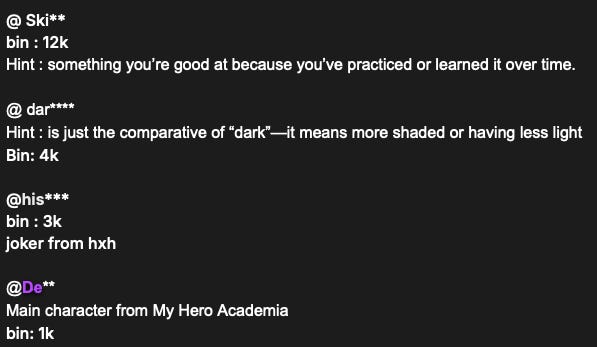
The current market of usernames typically covers social media platforms, popular online games, streaming sites (i.e., Twitch and Kick), and gamertags on Xbox and PSN. The mechanism is simple, just try to register usernames that are unregistered. Additionally, some sellers try to spot accounts that have been inactive for a while and get them banned so they can claim their username.
Prices: They vary wildly. A username that is an interesting/cool/zeitgeist word is worth more than another (e.g., @bitcoin vs. @table). If the word or acronym has no intrinsic meaning, rarity is a bit mathematically determined. For example, 3-letter usernames are more expensive than 6-letter usernames. Repeated ones (@ccc) are more expensive than gibberish ones (@jvp). And all-letters are better than a mix of letters and numbers. Prices generally vary between 2- to 4-digits, with some platforms being more expensive than others.
All these gigs are tedious. What’s worse is that we haven’t even talked about the most obnoxious part of it all, going to these forums everyday to post about your services and finding ways to distinguish yourself from the many other hustlers competing against you. None of these concepts are new. SEO has been around since early 2000s, same as hoarding usernames for their speculative value. I can’t imagine that people were not selling press releases since before the 20th century; paid slander probably existed in ancient times. The amazing thing is that, in 2026, there is still plenty of money to be made on the Internet if you have the grit. And, all these techniques are likely to continue coming back, again and again.
Adjacent Reading
Too many to list. Ask in the comments for academic papers about any of these topics :-)