


Recent Happenings
New reports on how users in China bypass restrictions imposed by Anthropic and resell cheap Claude tokens.
Krebs. FBI Seizes NetNut Proxy Platform, Popa Botnet
NetNut was a platform where you could rent residential proxies. NetNut was operated by Israeli company Alarum Technologies. NetNut was associated to the Popa Botnet.
When I arrived in the States in 2014, public sentiment against smoking was at an all-time low. Even at a big and proud party school (my alma mater: Dear Old State), you would’ve been hard pressed to find a newly-minted 18 year old with a cigarette in their hands. The eradication of smoking seemed near. The aggressive anti-smoking campaigns worked. Then Juuls launched. By 2018, the National Youth Tobacco Survey found a strong trend reversal; there was now a “vaping epidemic.”
Gambling, like vaping, is having a renaissance.
At first glance, a lot of people would disagree with my claim. After all, most people I know are unenthused about the prospect of Gambling. Several acquaintances went to Vegas this past year, yet none played a single game of Craps. You see, “Gambling is rigged in favor of the house: you are just gonna lose money lol. Nobody with any basic understanding of probability would unironically gamble. On top of that, everybody knows that casinos employ a variety of tricks to keep you there: you never see the light of day, free drinks, maze-like layouts, sensory overload, small rewards, etc. Casinos are evil. Gambling is sad and casinos are soul-sucking places: just look at those old people pulling those levers.” I hear some version of this every time games of chance come up. Yes, all valid points.
Somehow, this reasoning quickly dissolves when the conversation moves to other forms of monetized speculation. My best guess for why people don’t see prediction markets as gambling is because they feel like their knowledge gives them an edge. Translation: “my IQ buys better odds than yours.”
If you know how prediction markets and odds for Casino games work feel free to skip these next three paragraphs.
For the uninitiated, prediction markets (like Polymarket and Kalshi) are platforms that allow you to bet on events. If you correctly predict something happening you earn money. This is how it works. Imagine I can sell you two types of tickets. The “yes” tickets will be worth $1 if the US wins the FIFA World Cup. The “no” tickets will be worth $1 if they don’t. How much would you pay for each ticket? In theory, the price should approximate the probability of the event happening. If the US has a 1% chance of winning, then each ticket should cost 1 cent, because a 100% chance of winning is $1. Prediction markets let you bet on all sorts of outcomes, like whether Selena Gomez will attend Taylor Swift’s wedding (currently at 98%) or whether Putin will no longer be President of Russia by the end of the year (currently at 12%).
However, at the end of the day, you are just trying to make money off some possible future event that has some unknown probability of happening. You don’t really know what the actual probability of the US winning the World Cup is. You just know it’s kinda hard. On the other hand, France winning seems more plausible, so a higher probability makes sense.
The funny thing is that, for Casino games, we do have probabilities. Take the game of roulette. If the game of roulette only had 36 numbers, the probability of your ball falling on any number is 1/36. Let’s say I pay you 36 times your initial bet if you guess the correct number. If we play this game 100,000 times, you should expect to break even. We say that your expected value is zero. This arrangement would be boring and unprofitable. Nothing to play for. So let’s add a 0 and 00 to the roulette. Now, your odds are 1/38. However, I will only pay you 36 times your money if you guess the right number. In this case, your expected value is ever so slightly negative because I only pay you 36 times your money for something where you will only win 1 in 38 times. The Casino makes its money on the premise of thousands or millions of people playing games with negative expected value. However the expected value only really makes sense over a large number of trials. If we only play the game a few times and you hit your guess, then you can walk away with a gain. That’s the promise that the Casino holds.
End of explanation.
The appeal of prediction markets (along with stocks, crypto, and sports betting, and others) is that you can gain an edge through better strategies, more sophisticated mathematical models, more data, specialized knowledge, or “alpha.” Because of this, people seem to view these activities as different from Casino games, when in reality, in both cases people are risking money or valuables on an uncertain outcome with the primary intent of winning more money (see definition of: Gambling).
The appetite for Gambling, however, did not start with prediction markets. The modern era of popular financial market speculation came first, i.e. everyday people all of the sudden talking about NVIDIA financials and S&P500. I claim there are two events that made speculation in financial markets great again. First, the launch of apps like Robinhood (2013) that made it easy and cool to buy stocks with small amounts of money. But a few percentage points of growth quickly became boring as the cryptocurrency boom of 2017 took place. If you wanted to actually buy a decently-sized boat in your lifetime, you needed more volatility.
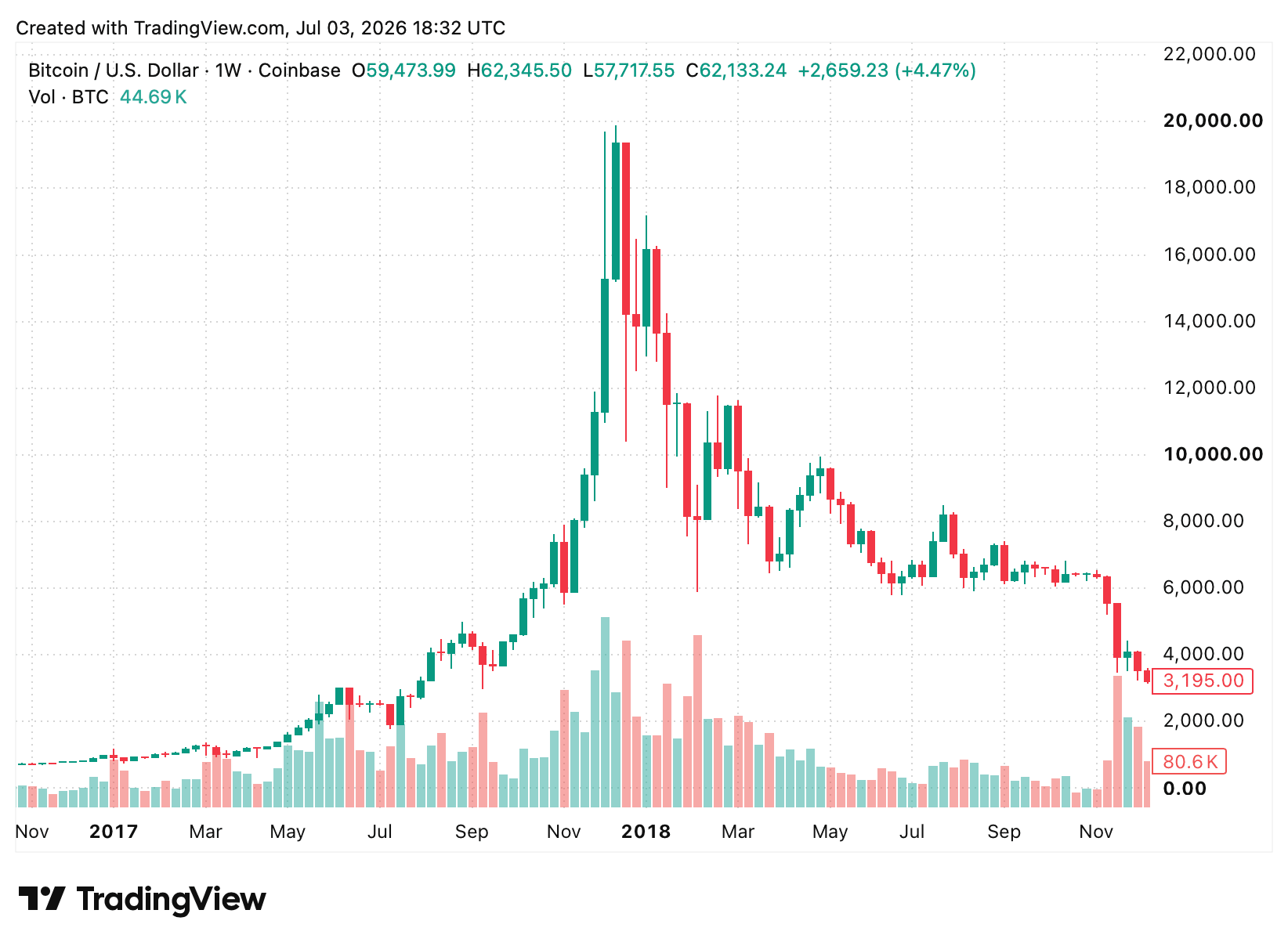
For many people, this meant graduating from “traditional” markets to crypto markets. The problem is that crypto at that time already seemed a little too degenerate and fraudulent. The huge drop in price from 2017 to 2018 did not help the public perception of crypto. Deep within, however, that first boom had planted the seed of FOMO. A lot of people accumulated cash and would not let the next crypto cycle pass them by. The crypto cycle also showed financiers that there was a lot of “retail money” (i.e., individuals and non-professional traders) to be taken. The masses wanted to gamble and financiers were eager to indulge them. By 2020-21 when a higher and more aggressive crypto cycle came around and people were locked down, there was a new generation of Casino games financial instruments to speculate on invest on. Pictures of apes and magical coins named after dog breeds for daredevils, or meme stocks and options trading for those who were afraid of Ponzi schemes and financial fraud.
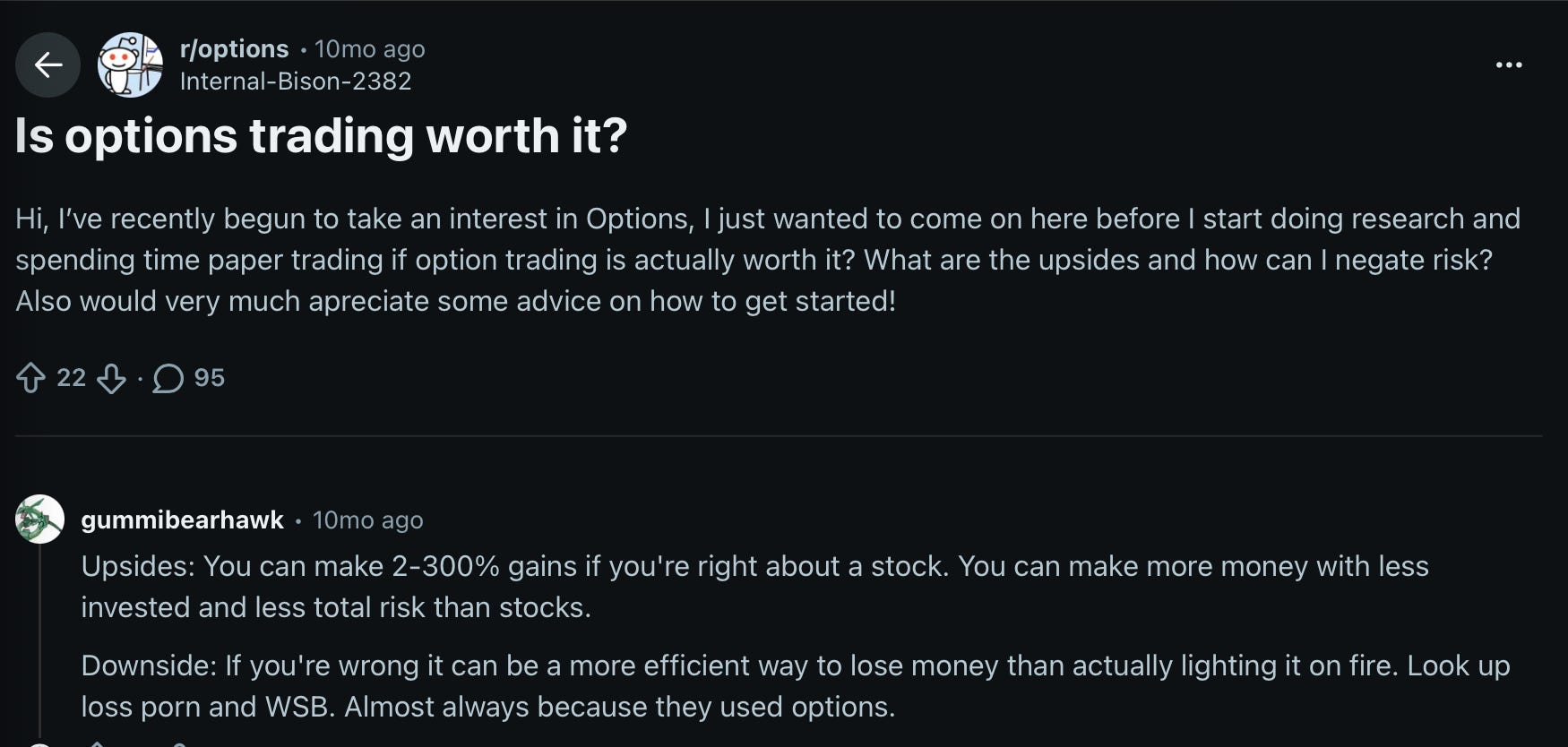
That manic cycle also ended in a deadly spiral of fraud. People discovered that you could right-click an NFT and save the image rather than purchasing it at a Sotheby’s auction––they had just been conned by grifters. The masses were fleeced; the music had stopped and a bunch of people had nowhere to sit. With Biden as President, it didn’t seem like the music was restarting any time soon. It was time to go to work and recoup the losses.
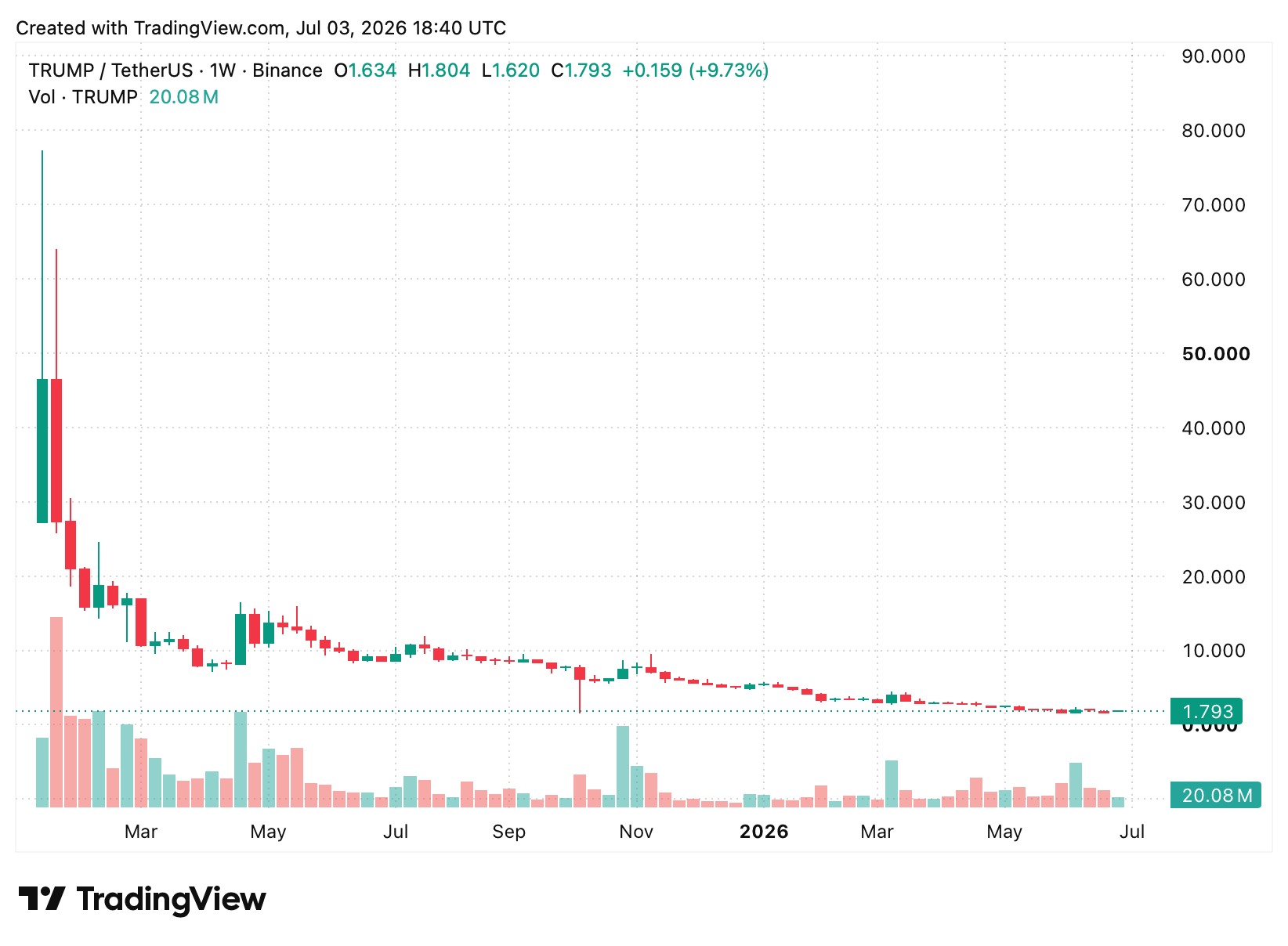
Seeing cars with crypto-related license plates or hearing about kids who made top dollar investing on defunct video game retailers, only spread the FOMO seed further. Once again, there was a group of people on the sidelines who were certain they would not squander their opportunity at generational wealth when the next cycle came around. And the cycle did come around. First, the AI era began, which meant we had plenty of companies to speculate on and tons of volatility to chase. But most importantly, the US elected a President that believes the numbers should only go up, especially for crypto. That’s how we got $TRUMP and $MELANIA coins, and also how the regulatory pressure on platforms like Polymarket were eased.
The main problem with crypto and “financial instruments” is that it can get very serious very quickly. Even though apps like Robinhood made the whole experience seamless. There are these terrible vibes that the IRS is breathing down your neck and that you need a tax professional lest you be thrown in jail. The whole thing just feels very technical. Managing wallets and private keys is unappealing to the layman. Reading financial statements, tracking the monetary policy of the US government, and monitoring geopolitical events, feels like homework. Boring and tedious for many. Much more amenable is the prospect of having a few drinks and betting who the winning couple on Love Island will be.
Many entrepreneurs realized that the appetite for Gambling is there, it’s just a matter of engineering the right product. This is the same realization we had with nicotine. Chewing tobacco is for hicks; nicotine pouches are for Wall Street interns. Cigarettes are provincial; cotton candy vapor is cosmopolitan. Today, we have a diverse portfolio of offerings to satisfy peoples’ Gambling needs. For the business school types who would enjoy Kiyosaki books, traditional financial markets. For the technical types who love volatility and have a distaste for regulation, crypto. For the brainiac know-it-all types who debate strangers on Reddit, prediction markets. And, for the jocks who want to smoothbrain a good time, sports betting. Pick your house.
The academic evidence for each of these activities is quite damning. But because the World Cup is happening right now, let’s zoom in on sports betting and prediction markets.
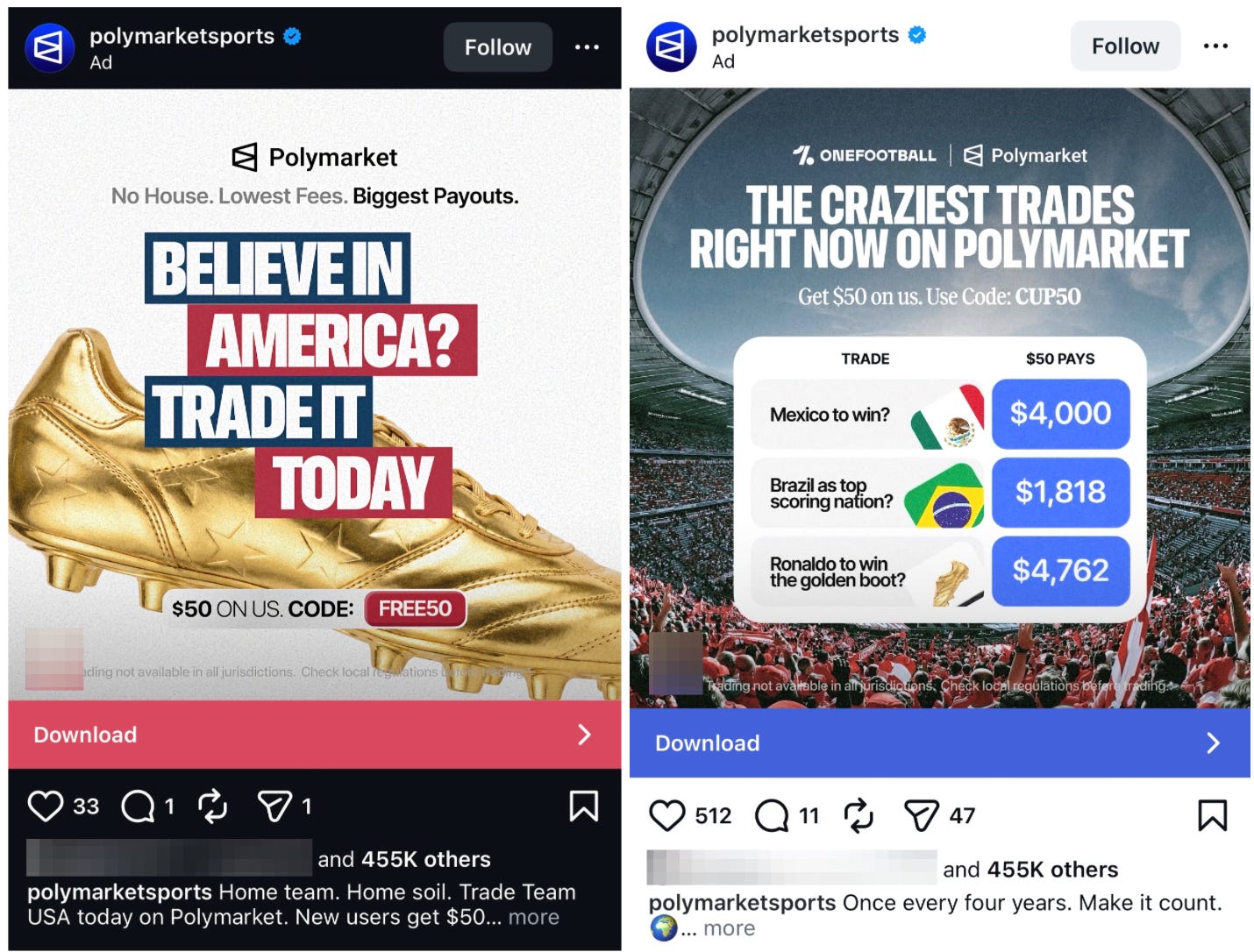
Nothing sheds better light on the zeitgeist better than ads at big sports events. In 2022, FTX was cranking out ads with Tom Brady and Larry David for the Superbowl, not least after buying the naming rights for the Miami Heats arena in Miami. At the World Cup this year, an AI rendition of the defunct Diego Maradona tells me to SHOW SOME BALLS in an advertisement for the online sportsbook and casino: BetWarrior. Every hydration break seems to have Kalshi, Polymarket, DraftKings, FanDuel, or another obscure platform. The ads seem to be working. In every watch party I attended this year, someone was praying their parlays hit.

The industry is hungry for new sheep. My Google search for one of these websites has now flagged me to all advertisers and I cannot seem to open Instagram without being prodded to place a bet. The entry offers are attractive: entry offers easily start at $50 for new people to discover whether they have the Gambling bug in them.
Sports betting was banned in the States. But in 2018 the Supreme Court gave back the power to the States to regulate sports betting as they saw fit. By 2020, Americans were spending ~$50 million a month. By late 2023, the national monthly handle hit $14.2 billion. Because sports betting has been around for quite a bit, the research is quite consistent: less savings, higher risk of overdrafts, maxed out credit cards, greater chance of bankruptcy (25-30% jump in filings), and even an increase in domestic violence––the effect of an upset loss on domestic violence in states with legalized sports betting is 10 percentage points larger. The evidence on prediction markets is a bit thinner but steadily trickling in. So far, we know that a small number of participants is completely wrecking the rest: the top 1% capture 76.5% of the profits. 69% of users lose money. I.e., if you are a pleb, you simply are NGMI, in crypto-speak.
Perhaps the deeper systemic issue is that we have engineered online environments rife with speculation. Paraguay plays against France tomorrow and I have been watching ticket prices all week. Maybe they will drop closer to the game. I heard that a lot of people bought tickets for the World Cup hoping to resell them. Maybe they will sell at a loss. Either way, If Paraguay qualifies, I can then try to book an airline ticket to Boston; I will have to do it before Monday since prices seem to go up then. And when I search for Uber rides the day of the match, I will surely check the price a few times hoping I can snatch the best price.
Monetized speculation has infiltrated so many areas of our lives. After all, why would Substack even let me insert this here?
PS: I don’t condemn your choice to Gamble. I’ve tried all the products described above. I’ve put money both in financial and crypto markets, in smart and dumb coins, in boring and risky assets; that’s Gonzo. I say, bet responsibly. But know that betting responsibly is hard because there is a whole industry trying to get your money, pushing you to be irresponsible, to take risks. So the systems are maximally extractive and rigged against you. There are PhDs in physics, math, and CS designing algorithms to beat you. You can get lucky, but that’s what it is. Luck. You will seldom (if ever) have an edge. Awareness of these risks is the best I can offer you.
Adjacent Reading
The Atlantic. Legalizing Sports Gambling Was a Huge Mistake
Soska et al. Towards Understanding Cryptocurrency Derivatives:A Case Study of BitMEX
Key finding: Most small accounts get fleeced, same as Polymarket.
Kawai et al. Anatomy of a Digital Bubble: Lessons Learned from the NFT and Metaverse Frenzy
Maradona AI Gambling Parody YouTube video.
“Remember, Gambling is illegal if you are underage. However, nobody is going to ask you your age nor verify your identity. Therefore, don’t do it.”