


Recent Happenings
The Atlantic. The Biggest Tell That Something Was Written by AI.
WIRED. xAI Asks Court to Strip Alleged Grok Deepfake Nudes Victims of Anonymity.
Krebs. Hackers Used Meta’s AI Support Bot to Seize Instagram Accounts
404. Companies Are Using Reddit to Manipulate ChatGPT and Google AI Search
In the summer of 1862, a traveler coming east from the Oregon Trail would see long stretches of sagebrush and volcanic rock, broken by narrow ribbons of water descending from the mountains. It was here that a few prospectors moved slowly through the valleys, stopping to pan gravel from creeks. They were looking for the same thing that men had been looking for before their time and even now in the present day, and finding it about as often as everyone else. It was in country like this that George Grimes and his companions began following the traces that would eventually lead them into the Boise Basin. Within months thousands of men would be traveling the same route.
A hundred and sixty years later, Justin Maier struck gold again. Seldom, if ever, does Boise appear associated with a technology company, less so with an enterprise dedicated to a concept that we cannot seem to define––Artificial Intelligence. For those “in the know”, Micron Technology might ring a bell, an enterprise that as many others has become a prime beneficiary of the modern gold rush by being in the industry of semiconductors. Micron’s computer memory chips are underneath many of the machines that today enable millions of people to write vapid sentences online, among other tasks. The Old West’s most famous adage was that prospecting was for gamblers; the business-savvy sold tools, shovels, pickaxes, and the like. Last week, Micron became the latest company to breach a trillion dollar market capitalization.
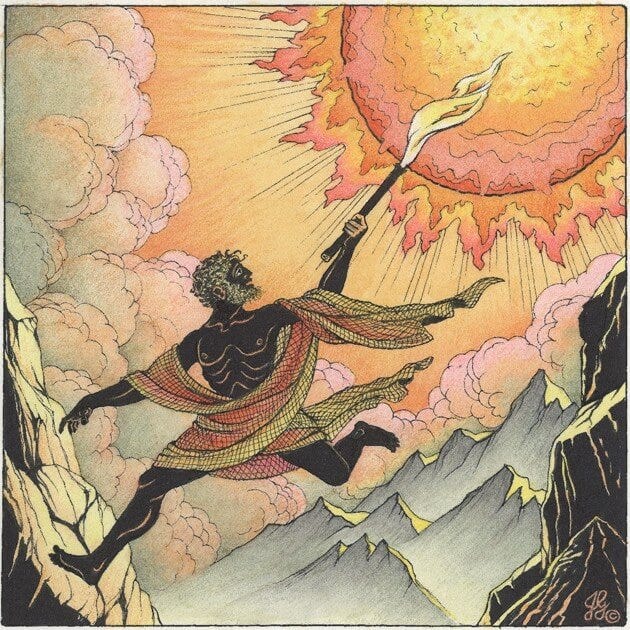
Justin Maier did not start Micron but had a similar idea to his Boise-based predecessors. If the electricity flowing through the runes carved in silicon rocks could generate language, then why not images and videos? A picture used to be worth a thousand words but today with far less you can transmute your imagination into digital pixels, and Justin’s CivitAI pioneered the modern alchemical workshop for mortals who do not know the `curl` or `npm` incantations. CivitAI has done an admirable job in breaking down the huge traditional barriers that separated noobs from wizards. The firm Andreessen Horowitz agrees. In 2023, after CivitAI surpassed 3 million users––only a year after launch, it secured venture capital funding.
Access to revolutionary technology has always been met earnestly by humanity. The Internet made vast troves of information available to the populace. Free encyclopedias and courseware from places like MIT were now suddenly available to barrio urchins and the promise of upward mobility was now attainable. People used the Internet to acquire knowledge, expand their cultural horizons, and create bridges of understanding with fellow humans from distant places. It stands to reason, then, that people will use these new artificial intelligence tools for the same noble goals. In exchange for making the world just a bit warmer each time, our prompts allow us to create better scientific illustrations, more effective didactic materials, and a completely new creative canvas for artistic exploration. Photography, with a single finger click, betrayed a generation of virtuosos who could achieve photorealism with brush strokes. AI-generated images promise to do the same and CivitAI is at the forefront of this creative revolution.
The computational generation of images first involves creating a visual encyclopedia––a massive collection of appropriately described images. Through the observation of millions of images including objects, scenes, faces, bodies etc., a computer is able to seemingly “understand” what a “dog running in a park” should look like. This procedure is called training a base model, and once your model is trained you can ask it to conjure anything your heart desires. Collecting that large set of images, however, is a pain, and training a model from scratch is tremendously expensive; the whole ordeal is often beyond mere mortals’ grasp. Some astute humans realized that sometimes you just need to tweak the model a little bit. To sway the model towards creating images of dobermanns rather than labradors, you just need to finetune the model a bit by feeding it a collection of dobermann pictures, a small adjustment; this procedure is much cheaper and accessible. The result is called an adapter, and the go-to platform where you can easily create, monetize, and showcase your adapters is called CivitAI.
A small segment of deviant readers may have consumed the paragraph above and contemplated the titillating prurient possibilities. Fortunately, CivitAI has implemented numerous safety features that would prevent an innocent visitor from stumbling upon lewd imagery. The homepage dissuades passersby by resembling those image-sharing websites of old that you would browse for desktop wallpapers. If a user needed to create an account on the website (e.g., to comment on a thought-provoking piece of art), the website provided users with a fine-grained filter covering PG, PG13, R, X, and XXX. Yet, despite their arduous efforts to contain the amount and intensity of obscene content on their website, CivitAI lost the ability to process payments through Visa, Mastercard, and the like.
Next week, we will find out why, and what they did in response. Hasta luego.
Adjacent Reading
None yet, just next week’s post!