


Recent Happenings
United States Seizes Domain Names Publishing Nude Digital Forgeries of Famous Women
Nansen et al. From Phreaking to Sneaking: Children’s Circumvention of Social Media Age Verification Systems
4chan takes down /r/Adult Requests
It was early morning in a Minneapolis conference room when I wrote down my first entry: “what is Porn?” This seemingly naïve philosophical musing was being heavily interrogated in front of a room full of clinicians, psychologists, economists, and one or two self-described prostitutes.
“I shall not today attempt further to define the kinds of material I understand to be embraced within that shorthand description [”hard-core pornography”], and perhaps I could never succeed in intelligibly doing so. But I know it when I see it, and the motion picture involved in this case is not that.”
Porn. You have likely come across it and hence “you know it when you see it”, as Justice Stewart famously wrote. Yet, academics insist that when you get down into specifics for scientific matters Porn is an elusive concept. It could be anything that involves nudity, or perhaps anything involving sex, ah, or perhaps anything that arouses. Who? The observer? If a singular thing excites a singular person, does that count? Yes, no, perhaps, maybe, and so on.
The American Institute of Boys and Men (AIBM)––an organization that focuses on modern male issues and vices––summoned us to make progress on these questions. Porn consumption is one of the most pervasive modern activities. Few genres are as omnipresent. Few Internet companies had as much longevity. Porn on the Internet was there before Amazon, Facebook, and several others. Today, few websites have more viewership than Pornhub. Yet, we know relatively little about why (people consume), how much (they consume), and what it does (to consumers).
The lack of progress on these questions was surprising to me, given that Porn consumption is likely as consequential as dating apps when explaining modern relational ailments and demographic trends. Or perhaps it is unsurprising, given that even just the definition of Porn seemed to evade us throughout the gathering, let alone more loaded terms like “outcomes”, “types”, and “The Porn Industry.” While we played in definitional quicksand, we were simply unable to square up with the big elephant that pranced around us: “is Porn bad/good?”
Porn may be bad if it’s harmful, but what’s harm anyway? Clinical psychologists opined that a thing was was only harmful contextually.
––What if Porn made you miss work?
–– If you are a millionaire then what’s the problem?
Medical doctors were quicker to be more prescriptive. After all, their field routinely involves telling people to stop consuming things like sugar or to not insert objects into orifices. Yet Porn is different. Gambling, for example, has both immediate measurable losses (outcomes) and an easier unit of consumption to wrestle with (time spent gambling). The latter may apply to Porn––or maybe it doesn’t, we don’t know. The outcomes part is what makes everything particularly tricky: we lack immediate measurable effects. The more concerning effects are more distant and a bit harder to measure.
A recent literature review by the AIBM summarizes the state of affairs in three levels. At the individual level, the clearest signals are behavioral: more sexual partners, more condomless sex, and for adolescents, earlier debut and greater likelihood of replicating what they watch. The more troubling finding is that of compulsive use––problematic pornography use is associated with worse mental health outcomes, though the causality direction is unclear. At the relational level the evidence tilts negative: lower relationship quality, less sexual satisfaction, poorer communication, and greater sexual objectification all show up consistently, as does some association with sexually aggressive behavior, though researchers are careful to note that men already inclined toward aggression may self-select into violent content rather than be produced by it. What experts have coined as a classic example of “la poule ou l’œuf.” An even bigger challenge here is that most findings rely on self-reported data (i.e., “stated preferences”). For something personal/sensitive/shameful/stigmatized/etc. Self-reported data can often diverge a lot from what people actually do (i.e., “revealed preferences”).
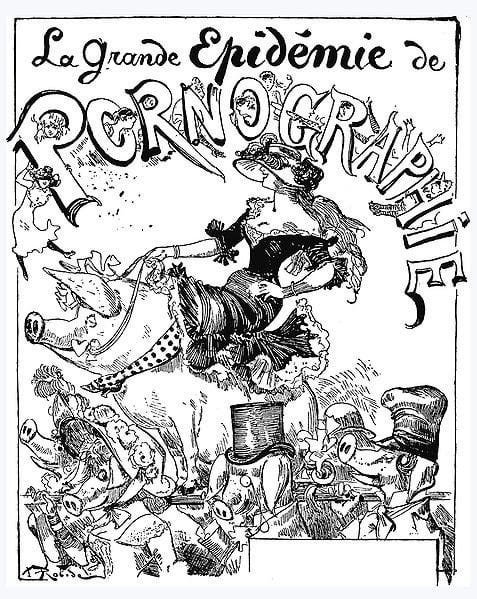

At the societal level the story gets more complicated. On one hand, population-level data do not show a clean causal line between increased pornography availability and rising sexual violence rates, even though specific practices like choking seem to be on the rise and related. On the other hand, plenty of articles suggest that the modern male teenager/adult is more depressed, more anxious, and forming romantic relationships later in life, and that Porn use may be playing a role.
Take ‘gooning’ culture: the subreddit /r/GOONED boasts 9.2M weekly visitors at the time of writing—one Paraguay’s worth of visitors. Why, you may ask, should we be concerned with chronic Porn use and masturbation?
Gooner: One who is completely and miserably addicted to porn but embraces and loves it.
Usage: I watch porn all day, I think I’m becoming a gooner...
Because Porn use may be deeply impacting the developmental abilities of new humans. The “male sedation hypothesis” offers an evolutionary perspective. Essentially, our biological wiring should push us to seek a mate. Our hormones scream their want of a sexual partner. Yet, the modern human can access quick sexual gratification and bypass the need of a partner. Why bother? The hassle involved in attaining a romantic relationship is not worth it. No need to go to the gym, develop a sense of humor, or cultivate interesting hobbies. In short, bypassing the hurdles involving the search for a mate leads to tremendous developmental setbacks1.
Many societal shifts seem to be removing the gains that come from connecting with each other IRL; Porn seems to be one of them.
Despite all these negative-sounding paragraphs there was an optimistic mist about Porn in the conference room. Somebody pointed out that good and bad are not on the same spectrum: “when thinking about Porn, the good and bad are independent from each other and can coexist alongside each other.” Makes sense. But, despite the attendance of pro-Porn representatives, the good effects of Porn––beyond its obvious ~entertainment~ value––seemed elusive. Don’t get me wrong, the entertainment alone is valuable. I recently learned how to bet on horses and putting a few dollars behind “Life’s a Puzzle” and “Papi’s Delight” made me cheer a little louder. But we understand that coming back to the track or a cigarette , over and over, is detrimental in the long run. For Porn, this is an open question, thus nobody could quite point where the source of the Pro-Porn optimism came from.
The best argument I heard was the educational angle. Perhaps sex ed vids may need to inherently be pornographic to teach teenagers a few things. Watch one, do one, teach one. In some schools, Porn was a Trojan horse through which sex-related conversations could begin, indicated some academics who lead big educational endeavors. Yet even then, researchers had qualms. There was a sense most available Porn is not suitable for the instruction of teenagers: interactions are unrealistic, consent is often not discussed, a lot of acts are disproportionately aggressive, etc.
At the same time, pornographers do seem to get over-villified at the regulatory level. Precisely because we don’t yet know what exactly it does to peoples’ brains, it is surprising to see the emerging wave of “online safety” laws, which are coming as age-verification laws. In this way, the academic and societal perspective of Porn resembles that of cannabis. The “devil’s lettuce” instilled fear and loathing in the populace, earning for itself a Schedule I classification, even though it had not been well studied. Eventually, tides began to turn and there was a growing sentiment that cannabis was perhaps not all that bad: that it’s comparison to drugs like cocaine was unwarranted; that it did not deserve the terrible stigma it got; and, that the positive health benefits likely surpassed the negative ones. This destigmatization has made it politically favorable for the US to slowly remove the barriers that inhibited cannabis research from taking place. Today, a similar loathing exists towards all things related to Porn. The current government has opted to just do without it. As per the attendees, it seems that federal research funds have become more scarce, causing scientific inquiry to be slower.
The smoke of hopium that Big Porn could step in to fund research was thick. After all, the state of scientific affairs regarding Porn research also resembles a whole lot the conversation around social media, so the same funding model could be useful here. Ah, but also tricky. It is not in the best interest of Big Social Media to fund research that may find that averaging 8 hours of screen time is bad, or that a constant exposure to artificially enhanced supermodels is bad for teenage girls’ perceptions of their bodies, or that early age short-form brainrot content is likely assaulting the neural pathways of children. Big Porn may have similar qualms.
I imagined that Big Gambling would also have similar reservations. Yet, the International Center for Responsible Gaming (ICRG), which is funded primarily by casinos and betting apps, exists. The additional advantage of this model is that creating a mediating body between the funders and the researchers, may reduce bias in the research that is done (we hope). This may at least alleviate the funding gap that currently exists. However, data access is an equal if not bigger hurdle. The data needed to do meaningful research is controlled by the entities that need to be researched.
Emerging information technologies like social media, search engines, and AI can have a broad impact on public health, political institutions, social dynamics, and the natural world. It is critical to develop a scientific understanding of these impacts to inform evidence-based technology policy that minimizes harm and maximizes benefits. Unlike most other global-scale scientific challenges, however, the data necessary for scientific progress are generated and controlled by the same industry that might be subject to evidence-based regulation.
Joe Bak-Coleman’s abstract here could easily also include “Porn” and still hold true.
When talking to Big Porn emissaries at the conference, I opined that we needed better data access. Their fear, as I heard it, is that <<they>> (Big Porn) get persecuted a lot as is and releasing data or starting collaborations with academics simply increases the surface area for risk. Maybe so. But it also feels like an easy cop out. Is there really no way to make data repositories available that could fuel meaningful research á la Yelp? Pornhub has a team that publishes Insights. A data release is not far off. Given the growing interest in regulating online activity, particularly as it relates to obscene material, researchers will find a way to study Porn consumption; it will be easiest if we can do it in formal collaborations.
The overall picture is that modern Porn consumption is probably doing something to the people who use it, something to their relationships, and something harder to trace at scale. This seems frustrating at first glance. At the same time, being in a position where there’s so much up for grabs is academically exciting. Uncharted territory: plenty to discover and massive stakes.
Porn may be like social media, cannabis, tobacco, gambling, or something else entirely. The conference couldn’t yet say, but we were all eager to be the ones who figure it out.
I was invited to participate in this AIBM summit, who generously sponsored my attendance. Huge thanks to David Sasaki for the invitation, the team (Raman, Anders, Jon) for organizing the event, and all the phenomenal people I met for the elucidating conversations.
Adjacent Reading
Reeves. Of Boys and Men
Costello and Buss. Why isn’t There More Incel Violence?
Malamuth et al. Factors predictive of sexual violence: Testing the four pillars of the Confluence Model in a large diverse sample of college men
Reid et al. Shame, Rumination, and Self-Compassion in Men Assessed for Hypersexual Disorder
Way et al. The Landscape of Pornography Use by Men in the United States
Maheux et al. Associations between adolescents’ pornography consumption and self-objectification, body comparison, and body shame
Grubbs and Kraus. Pornography Use and Psychological Science: A Call for Consideration
For an extreme version of maladaptation, see impact of Internet on social reclusion in Japan (i.e., hikikomori).