


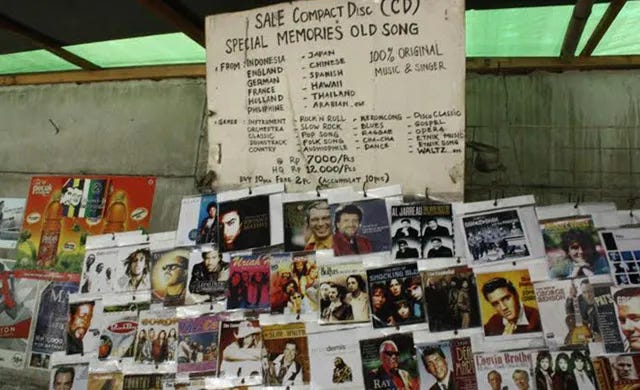
Source: https://www.vice.com/da/article/humans-of-the-cd-street-stall-who-still-buys-pirated-discs/
Last week we discussed why there’s a surge of gig workers that will create AI porn for you. To explain this phenomenon, I talked about money and markets. It comes as no surprise that sex and money go hand in hand. And because of this a lot of the interventions that scientists and lawmakers discuss are centered around money. Last year, a group of state Attorney Generals sent a letter to payment processors telling them to do more. Adding financial friction is powerful: you make it unprofitable and annoying to pay for something and people walk away. This is part of the reason why we are not sending each other crypto when splitting dinners.
However, the underlying assumption is that most people are primarily money-motivated (a.k.a. “finacially-motivated rational actors”). Weirdly, some people are not. Some seem to be guided by morals, values, ideologies and such. Our financial enforcement measures would work if it were not for these pesky ideas.
A Short Intro to Piracy
Somehow we landed in a reality where people pay for the right to stream music and movies. In the 2000s this seemed unconceivable, laughable even. Limewire, Ares, Bearshare, ThePirateBay, (I can keep going), provided uninhibited access to any and all digital needs. They still do. But, the hassle of figuring out how to pirate properly, the fear that you might download malware, and the worry that your Internet service provider will send you a threatening letter have pushed people to more convenient options. Piracy, though, is still alive and well, powered by a community of committed enthusiasts.
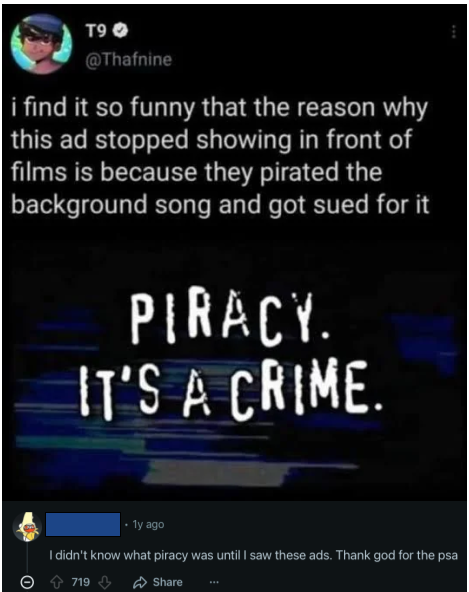
Sources: https://www.reddit.com/r/Piracy/comments/1k8jtd6/lmao/ [1]
Piracy gets a bad rep. Probably because of the edgy ad campaigns equating piracy to stealing cars and unsuspecting women. Yes, piracy can suck. It can really harm creators––especially smaller ones––of movies, music, books, etc. But piracy also has served a variety of noble goals. For example, if you grew up where I did, you just couldn’t buy certain stuff, even if you wanted to. You wanted to buy a Windows XP license? Good luck. On top of that, prices were tremendously prohibitive for us wretched and proud inhabitants of the developing world. An Adobe CS6 license would cost ~$2,600 according to this Reddit user. That was just about the minimum wage in Paraguay in 2010... for one year of work. Maybe you hold the opinion that kids from the barrios should not access digital goods they cannot afford. But those kids also wanted to play Warcraft 3, watch Full Metal Alchemist, and make beats with Pro Tools. Thank you pirates for your service.
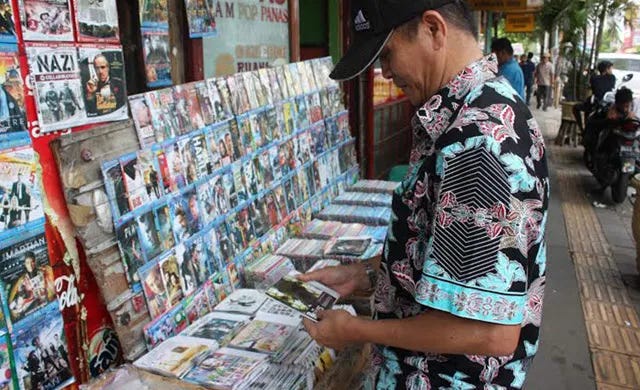
Source: https://www.vice.com/da/article/humans-of-the-cd-street-stall-who-still-buys-pirated-discs/
A lot of pirating groups have a strong code of conduct and ethos. These groups, which roughly trace back to early hacker/technolibertarian cultures are of course not a monolith. Id est, there is no unified cultural umbrella or dogma that governs all self-declared members of the aforementioned ideologies. However, there are a few generally accepted concepts: free access to information, anti-corporate sentiment (stick it to the man but not to indie creators), archival (preservation of content), sharing as reciprocity, and technical prestige (”I pirate faster, better, quicker”). These values also exist in many other communities like open source software and open access.
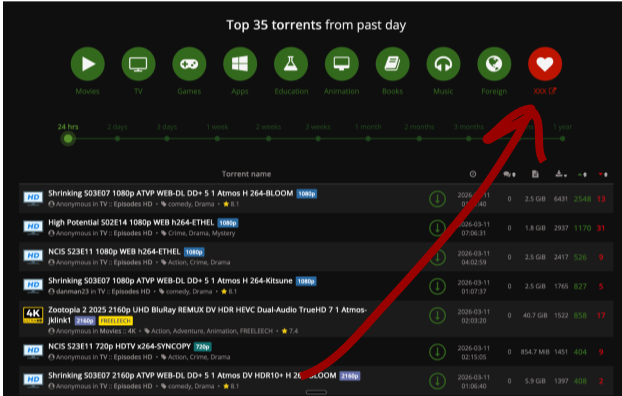
Source: iykyk.
There is another highly pirated media category: porn.
Porn Piracy
As you would expect, porn is pirated because of paywalls and because studios thought that $25 dollars for movie access at a hotel made sense. When tube sites like PornHub and YouPorn launched in 2006-2007, porn studios saw their revenue collapse. These sites allowed anybody to upload content, so users began uploading pirated scenes en masse. Big Porn tried to fight tooth and nail with lawsuits and takedowns. But, like other media producers, pornographers ultimately adapted and found ways to make people open their wallets. OnlyFans as a whole grosses billions of dollars per year; top earners in the platform make millions. Of course, the same battle that porn studios fought against pirating communities are now being fought by individual content creators. Today, there are several online communities dedicated to procuring, indexing, and distributing paywalled content belonging to OnlyFans models. Where there’s paywall, there’s a leak.
Porn piracy may seem like it is primarily a financial thing. But porn is an attractive candidate for piracy not just because it is often paywalled, but because ‘til this day, porn also pushes censorship boundaries. In the US, dirty films can still be cataloged as obscene if they do not satisfy the Miller test. In Japan, porn is obscene if it displays genitalia (hence why it is blurred). In several countries, porn is outright banned. But boy, people do not like it when music/films/books are banned or censored. Take books as an example. One of the largest shadow libraries traces its roots to Samizdat––an underground movement to resist book censorship in the Eastern Bloc. Today, we still celebrate banned books week. If Sarah Maas books were banned tomorrow, the riots would be violent. When pornographic content is banned, it triggers the same ideological knee jerk reaction: people want to preserve and redistribute the content, they want to fight back, lest their freedoms be trampled.

Source: <redacted>
Porn Preservationists
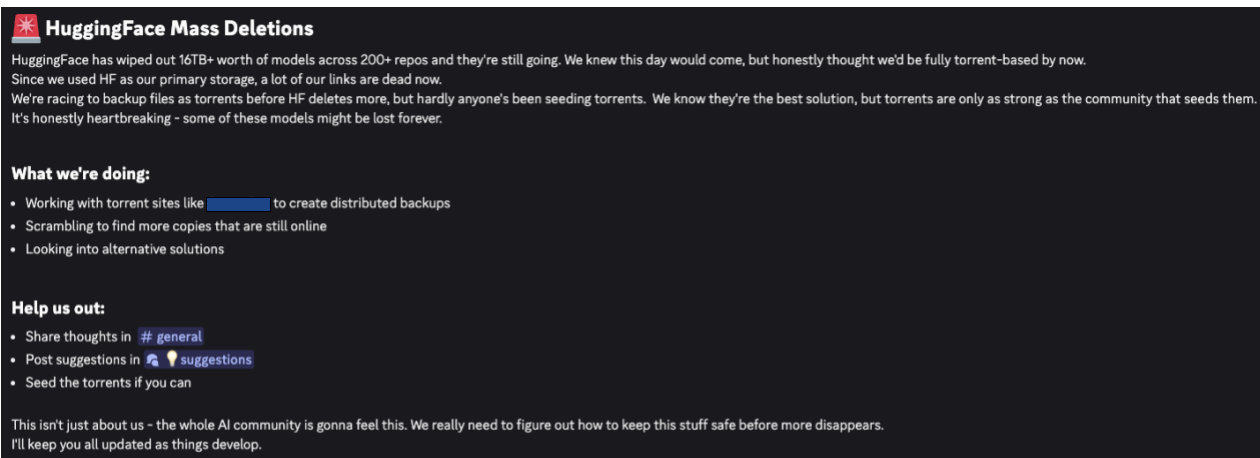
Last year, HuggingFace and CivitAI suddenly started taking down AI models used to generate deepfake porn (or synthetic non-consensual explicit imagery for long). Other adjacent platforms like SeaArt and TensorArt went farther and even took down all adult-generating content. These actions came as a reaction to a period of heightened scrutiny by lawmakers: the UK began enforcing its Online Safety Act, the US passed the TAKE IT DOWN Act, journalists and scientists began demonstrating the prevalence of deepfake porn in these platforms, and so on. We published a paper on the impact of this regulatory pressure on the ecosystem of deepfake pornography. Now, what we did not capture in that paper was this underground movement that quickly took place after platforms began taking down these models. The key difference, of course, is that the content being preserved here is not Dr. Zhivago, but an AI model that can generate Hermione Granger’s nudes.
Days after the purge, I came across several initiatives oriented at preserving these porn-generating AI models that were getting taken down. It was like a natural catastrophe hit and these netizens were tasked with orchestrating a sort of humanitarian response. Volunteers emerged. Missing model posters were put up. People shared their libraries, others dedicated hard drives for storage, others offered to design databases and build the necessary tooling. And as if the library of Alexandria was in flames again, they mourned the models that had not been saved: lost treasures that future generations would never get to appreciate. They vowed this would never happen again.
Source: <redacted>
Today, one community dedicated to the preservation of deplatformed AI models has over 4.5k members. There’s a version of this story where that number stays small. But the more instructive version is the one where it doesn’t, where the same cultural infrastructure that allowed kids from Ciudad del Este to buy PlayStation games now keeps non-consensual imagery of real women circulating indefinitely, powered by people who genuinely believe they’re on the right side of a censorship fight. That belief is not entirely irrational. Enforcement has consistently struggled against ideologically motivated communities, not because the ideology is correct, but because financial friction is a weak tool against people who aren’t primarily motivated by money. The piracy wars taught us that. Here we go again.
Further Education
A very pixelated view of Ciudad del Este from back in the day:
A mall in Ciudad del Este:
An FBI note with the same tone I use in these blogs: https://archives.fbi.gov/archives/news/stories/2004/may/piracy_051704
Book: “Media Piracy in Emerging Economies”
“Relative to local economies a copy of Microsoft Office is 5-10 times higher than in the US or Europe”
I found this piece after I finished writing this blog post.
Footnotes
[1] Apparently, the anti piracy ad shown above was not the one pirated, but the universe in which it was is funnier https://torrentfreak.com/sorry-the-you-wouldnt-steal-a-car-anti-piracy-ad-wasnt-pirated-170625/