


Recent Happenings
NY Times. Political Campaigns Are Quietly Paying Influencers to Support Candidates
A deep dive on the pre-loaded malware that comes installed in cheap TV boxes
I’ll do a follow-up on the TV boxes story
FBI. Malicious Cyber Actors Gain Access to Victim Accounts Through Consent Phishing
The Guardian. Fake US thinktank set up and funded by Israel sought to game AI for propaganda
Sorry for the hiatus. I went on vacation and then submitted a paper. I’m still getting used to the dynamics of this operation. But we are now back in full force at our weekly interval.
Some of the things I have planned for this semester include buying questionable digital goods, an explainer on TV box malware, and adding unsuspecting email addresses to a Substack publication to see what happens.
The latter was suggested by a recent subscriber! If there are any other weird online things that you want investigated, send me a note.
A few days ago, there was a storm. The wind rattled the windows of my apartment, and the rain eliminated any prospect of venturing outside. I sat alone in the glow of my computer screen and found myself missing something I had not thought about in a while: belonging to an online community.
Growing up in Paraguay, I spent many subtropical evenings talking about overclocking and PC modding with a few dozen other enthusiasts. JOPY was Paraguay’s leading––and, for a while, only––online geek community, and I was one of the stewards that kept this space clean, tidy, and informative.
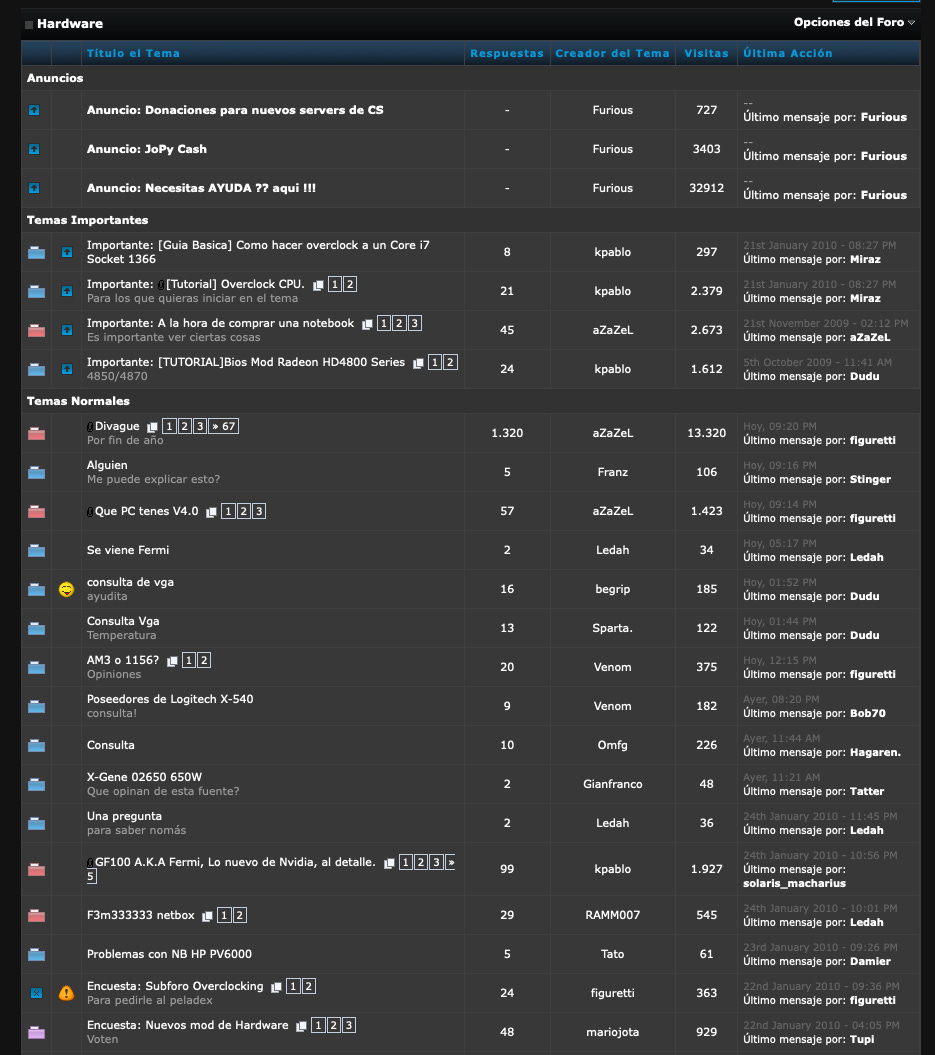
Back then, Robert Kraut and his colleagues had not yet written this book on successful online communities. Today, we have words like “incentives” and “sociotechnical lenses” through which we can academically explain these spaces. Back then, however, what I knew was that this community was my online refuge, a place that I happened to co-create with these people I had never met.
But JOPY is no more and nothing has replaced it.
Online communities, like Paraguay’s forests, have been eradicated––cleared away and put to more profitable uses. Wanton extractivism and disregard of the virtual biome have caused this: every conversation can be made into content, every gathering converted into an audience, and every niche interest fed into a personal brand.
Derek Guy––the menswear guy who is somehow always first in any online feed––often complains that nobody wants to write about their “niche little interests” anymore. Doing something for free seems irrational. Put it on Gumroad. Make it a subscription. Hide it behind a paywall. Link in bio. Gone are the Blogspot pages maintained for twelve years by a zealot with no discernible motive beyond caring too much about the subject.

A few actual communities have survived. Like endangered species surrounded by armed guards and strict rules, these communities endure by gatekeeping the hell out of newcomers and punishing bums, freeloaders, and other miscreants with no mercy.
One such community has been around more than twenty years.
In it, members maintain an enormous shared archive: movies, software, books, and other cultural artifacts. To call this simply piracy would understate the infrastructure that maintains this operation. Members catalogue material, correct errors, and enforce standards. When an obscure piece of media is missing, members procure it. And, everybody lends their bandwidth proportionally to how much they take.
There is no algorithmic feed, public recognition, nor financial compensation. You simply get to pluck from this massive community garden you tend to. The produce just happens to be movie releases like Nolan’s Odyssey.
This community is known as a “private tracker.” To understand what this is, we need to talk about torrents.
A torrenting explainer
A normal download on the Internet is like buying a table from a shop. The shop has the item you want, you request it, and the shop gives it to you. A torrent works differently. You ask something from the clerk, the clerk makes some calls, and tells you who has what so you can go fetch those. The clerk simply helps everyone find one another.
Put more precisely, when you are torrenting a file, you are typically downloading many small pieces provided by different computers. There is no central server holding the file, but rather, a group of computers organized by the tracker (i.e., the “clerk”). Downloading a file is known as “leeching”, while uploading a file is known as “seeding.” A popular new file (like The Odyssey) may have hundreds of seeders, while an obscure French noir film from the 60s may exist in just one computer. A tracker coordinates the seeders and the leechers.
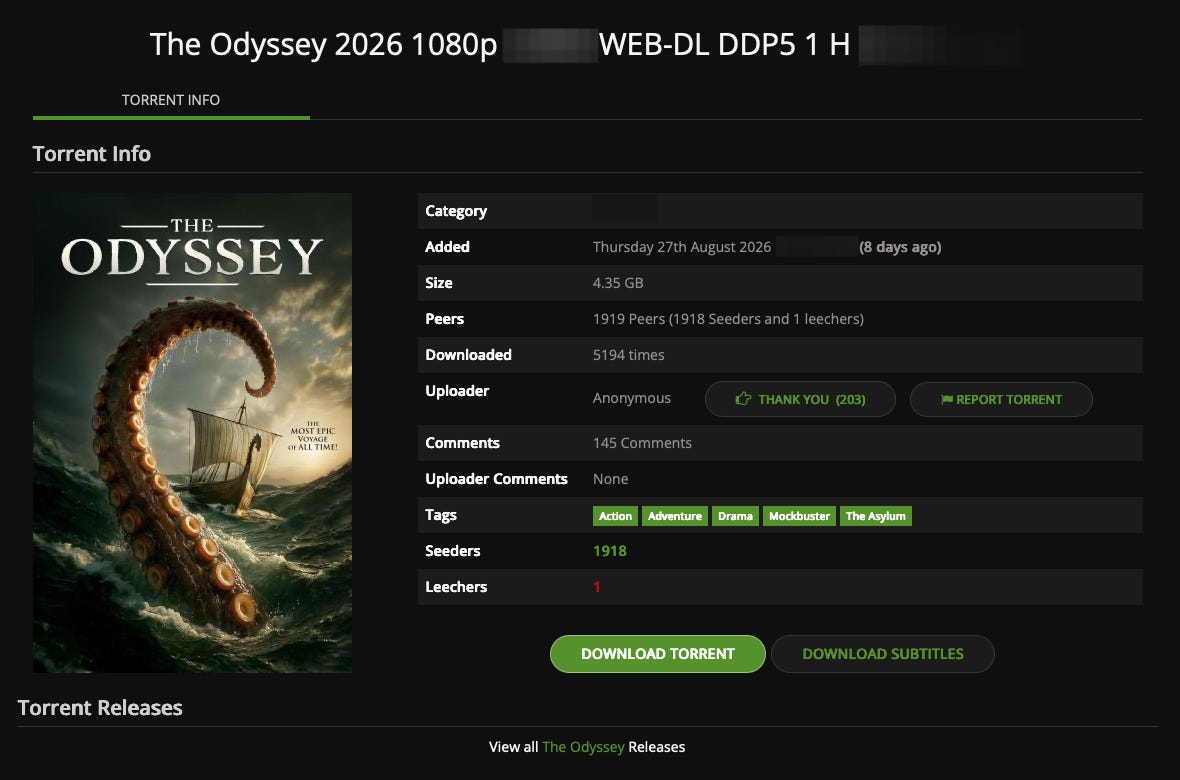
What makes a tracker “private” is that it requires authentication. Only a select group are allowed—good trackers often require invitations. Contrast this to “The Pirate Bay” or any other place where anybody can seed and leech. Both use the same underlying p2p protocol. The difference is social organization.
When you begin downloading, you will also become an uploader. You become a computer in the swarm, sharing the file you now have with other computers. Technically, you can disable uploads and prevent your computer from uploading the file. In a public tracker, doing so is merely gauche...rude, like failing to return a shopping cart to its corral. No repercussions for those who do not subscribe to concepts like a “social contract” or a “moral compass.”
In a private tracker, however, you are sentenced to death.
The sin of leeching without seeding is called a “hit-and-run.” Private trackers take this seriously because if everybody behaves like a miser, eventually nobody can download anything. This principle applies to public parks, office kitchens, civilization, and pirated Blu-ray remuxes.
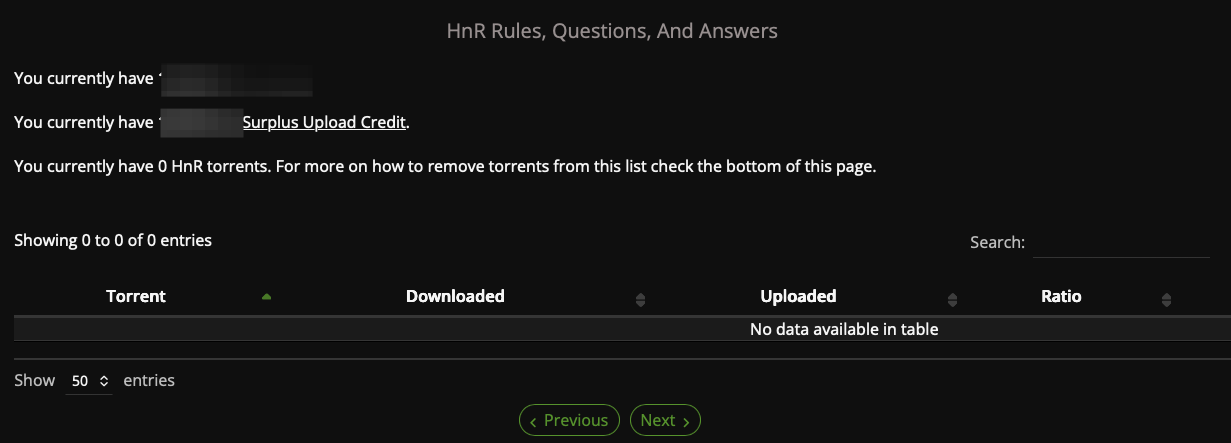
Thus, you shall only download in proportion to how much you seed. If you seed 10GB, you can leech 10GB with a clear conscience (and no fear of punishment). Having more bandwidth seeded than leeched is called having a positive “ratio.” Maintaining a healthy ratio requires some combination of patience, desirable files, a decent Internet connection, and a computer that remains online. Different trackers have different rules, but the essential arrangement remains: you may take from the archive because you help preserve the archive.
This creates incentives to obtain desirable material quickly. If you are the first to get The Odyssey up, you will be seeding a lot of GBs to anyone who wishes to witness Nolan’s desire to do another Batman film. This, in turn, will allow you to leech many files. Take a penny, leave a penny. It is remarkable that this degree of cooperation among strangers still exists anywhere on the internet.
Honor among thieves
You might be wondering about trolls and other undesirables. Who cares if you get banned? Get another account and let it rip. Why not?
The people running these trackers appear to have independently discovered the academic literature on community design. Buried on page 161 of Kraut’s book, he writes that an effective way of keeping people in line is by tying members’ reputations to the newcomers they invite.
Sponsors know both the candidate and the community. They have an incentive to invite people who will fit, teach them the rules, and prevent them from becoming liabilities. Newcomers, meanwhile, have an incentive not to embarrass the person who vouched for them.
This is what this looks like in practice: My friend E invited me and said:
“I worked hard for this invite, pls read the rules and please don’t **** up or I’ll be hurt.”
This worked remarkably well. My account has been active and in good standing for almost 10 years now. And yes, I seeded because I wanted to keep my account and because I did not want E to suffer the consequences. Eventually, this became a habit. I knew what to do so my client stayed online and available. Then, it became a duty: I left files online because someone, somewhere, might need them. And finally, I felt a sense of pride for this whole operation. Self-interest had been successfully converted into stewardship.
What is community?
Calling a private tracker a community may seem generous. It is not a place most people go to chat, and many of its members may never visit the site’s forums or IRC chat.
But community does not always take the form of friendship. Sometimes it consists of people accepting obligations toward strangers.
This is the part of online community that our modern platforms have discarded. The Internet stopped feeling peer-to-peer and became one-to-many consumption funnels. Parasocial relationships are the norm and personal convenience trumped community––in and out, as fast as possible, with no eye contact, and no explanations. Tending to your community is inconvenient: it forces you to remember rules, collaborate with people you may not like, and undertake responsibilities. “I’ll just buy my tomatoes from Netflix, tyvm.”
JOPY was a warm place. We talked, argued, and taught one another things. A private tracker has not replaced it. But it has preserved something that most of the internet lost: the expectation that membership comes with duties.
My computer is still online, holding pieces of an archive. It is a pain to maintain and most of the files are sitting there idly. But, every now and then, a stranger comes along and picks a fruit for the road.
Adjacent Reading
Robert Kraut’s book, duh
Social Media Is Now Parasocial Media — danah boyd