


Recent Happenings
The editorial desk barely made it this week as I was at a conference (which you will hear about soon). That said, it is still Friday here in Minneapolis (with 2 minutes to spare), so all’s good. This is the continuation of last week’s post on the CivitAI saga. Note, this post does include some description of nasty stuff, so, buyer beware.
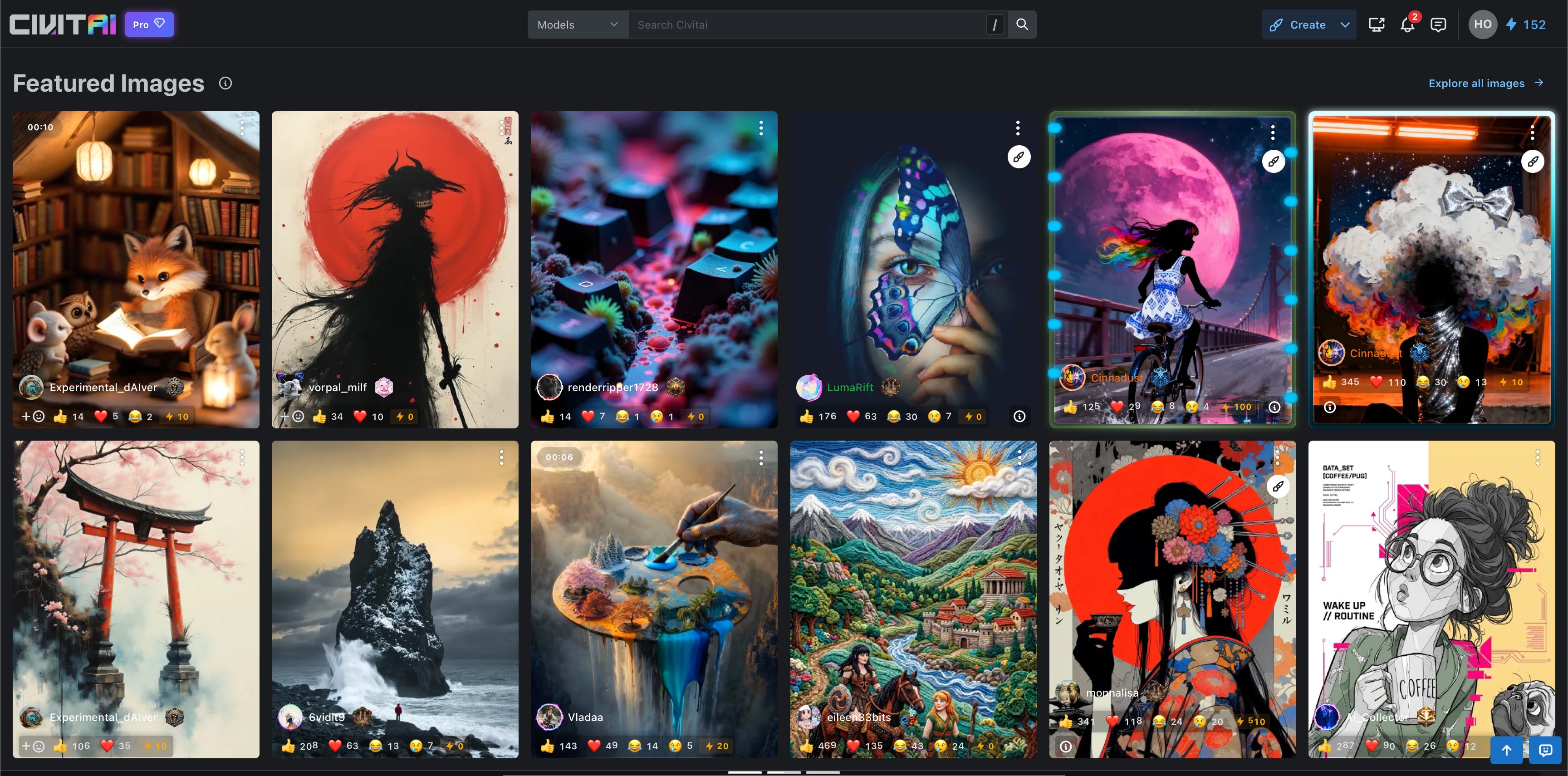
CivitAI prefers to describe itself as a platform, a community, and sometimes a marketplace. These convenient designations are conceived to avoid uncomfortable questions about the content that is shared. They are just a platform after all, and as with any ecosystem, there are just a few bad apples; it would be unrealistic for CivitAI to catch these perverts. So the story goes for all those who seek refuge behind the mighty Section 230––the same bulwark that shields social media companies of user-generated content liability. Regardless, CivitAI takes content moderation seriously and as a consequence has implemented numerous safety features that would prevent an innocent visitor from stumbling upon lewd imagery. The homepage dissuades passersby by displaying images that I imagine adorn the walls of AirBnb rentals marketed for bachelor retreats in Miami and Palm Springs. And, after creating an account, they provide a useful set of filters that allows you to block all the indecent content.
The ability to describe any image or video you want has seemingly not resulted in the advancement of noble goals. Instead, the most popular adapters––each boasting hundreds of thousands of downloads––showcase instructions that look like this:
“A footage|iphone video from 2000s|vintage 1970s|futuristic 8k} {pov|side-shot|top-down xxx pov|4k video} of a {tiny|emasciated|young|18-year old|cheerleader|pale goth|petite|rail-thin|plump teen|fat|full-body} woman {bent over her bed at the waist with her stomach and chest flat on the bed|on her hands and knees|bent over presenting her pussy and anus|bent at the waist reaching toward the ground with ass up|face down, ass up}. She has {white|black|olive|fair|tan-lined|thai} skin {small|huge|a-cup|DDD} breasts and {long straight|wet|pink|black|rainbow} hair and is having her {tiny pussy|butthole|anus|vagina|puffy little vagina|hairless pussy|hairy vagina|4K pussyhole} penetrated in and out repeatedly by one man’s modest sized erect penis, slowly but totally in and out as she looks back toward the camera and POV man fucking her. The background is {other young ladies gather around to gain the experience of watching her suck the penis, watching in lab coats that are open exposing their naked bodies in the background|in a church confession booth}”
Words between the brackets indicate customization possibilities.
If you were to run the instructions above, you would most likely receive an “artificial” woman. A depiction of someone who looks like a real person but does not actually exist. This provides little comfort. In a world where there are online tools that take Instagram handles, retrieve all pictures, and automatically create sexually explicit media and corresponding adapters, then the fact that we have “a deepfake nude epidemic” is not merely explained but entirely logical. Boys and men are sacrificing maidens at robotic altars in rituals of pleasure.
Pesky observers quickly caught wind of this practice. The chickens––along with two large condors––had at last come home to roost and the reports that CivitAI was enabling the creation of non-consensual explicit images (i.e., “deepfake pornography”) and “content that could be categorized as child pornography” entered the public conversation. The bad air emanating from Boise could no longer be ignored. Early in 2025, a crackdown seemed imminent: the UK began enforcing its Online Safety Act (OSA) in March and the TAKE IT DOWN Act cleared the US Congress in April––both laws covered deepfakes. In the background, payment processors had begun pressuring platforms like CivitAI.
By the end of April, CivitAI announced a sweeping change in their policies, highlighting some of the content that existed in the platform in its fourth year of operation:
We’ve updated Section 9.6 of our Terms of Service (ToS) to explicitly prohibit content depicting:
Incest, including sexual activity between immediate or close biological family members.
Self-harm, including depictions of anorexia or bulimia.
Content that promotes hate, harm, or extremist ideologies.
Bodily excretions, and related content;
Urine
Menstruation
Smegma
Diapers
Additionally, content in the following categories which depicts sexual activity or context that insinuates, or portrays, sexual intent (X, XXX) is explicitly prohibited;
Firearms aimed at or pointed towards individuals.
Vomit.
Depiction of illegal substances or regulated products (e.g. narcotics, pharmaceuticals).
Content depicting sexual activity while in a mind-altered state is prohibited, including;
Being drunk, drugged, under hypnosis, or mind control.
From: https://civitai.com/articles/13632/policy-and-content-adjustments
Remarkably, CivitAI misjudged the political climate and did too little in the two departments that mattered the most, opting for simple interface (UI) filters. Sexual images of real people were allowed to stay but would simply be hidden. And, content with child/minor themes were allowed to stay for the R category which they describe includes “adult themes and situations, partial nudity, bikinis, big bulges, sexual situations, and graphic violence.” Yikes.
cont.
We make certain types of content less visible across the platform depending on the content you have enabled in your browsing settings:
Real people and celebrities: Content tagged with real person names (like “Tom Cruise”) or flagged as POI (real-person) resources will be hidden from feeds.
Minor content: Content tagged with child/minor themes is filtered out of feeds whenever mature content (X, or XXX) is enabled.
By May 18th, CivitAI realized the error in their ways.
cont.
Update 5/18: Content filtering rules were extended — minor-tagged content is now hidden whenever mature content (R, X, or XXX) is enabled, not only X/XXX.
Soon after, they also reeled back their policy on depictions of real people, albeit a bit more begrudgingly.
We are removing models and images depicting real-world individuals from the platform. These resources and images will be available to the uploader for a short period of time before being removed.
We know this will be frustrating for many creators and users. We’ve spoken at length about the value of likeness content, and this decision wasn’t made lightly. But we’re now facing an increasingly strict regulatory landscape - one evolving rapidly across multiple countries.
From: https://civitai.com/articles/15022/policy-update-removal-of-real-person-likeness-content
Needless to say, these concessions were not deemed enough by the payment providers. On May 22nd, three days after President Trump signed the TAKE IT DOWN Act, payment processors rescinded support for CivitAI. Capital punishment. Without the ability to collect money from users, you will have a hard time delivering shareholder value. CivitAI is not the first company to face this dilemma. In 2020, Visa, Mastercard, and Discover cut ties with PornHub after an investigation which stemmed from a piece on the NY Times titled “The Children of PornHub.” The legal imbroglio dragged on all the way to 2022, when payment processors proceeded to go the extra mile and also cut ties with ad arm of Pornhub owner MindGeek. Until this day, the only two payment options for a premium membership are ACH transfers and Bitcoin.
Ahh crypto… the magical wand bypasses all sanctions and regulations. The bane of a regulator’s existence. Within a few days, CivitAI was relegated to also accept ACH transfers and cryptocurrencies. “If it wasn’t for crypto, these fascists would not let us have any fun on the Internet. To hell with these moralistic dictators and their concerns. Debauchery for the masses!” Cryptocurrencies have now existed for 14+ years. 10 of those have been in the light of popular culture with massive funding cycles, substantial development, and even two countries adopting cryptocurrencies as legal tender. If the cryptocurrency dream is alive and well, then it should be ezpz to swap out those suckers payment processors and rely on crypto. Users on CivitAI, by virtue of being consumers of a relatively niche AI product, are presumably tech-savvy and able to whip out the future of finance to avoid Visa and Mastercard’s sanctions. Or are they?
Next week, we will wrap up the last bit of this story and talk about what modern CivitAI looks like and what their trial and tribulations with various payment processors tell us about the effectiveness of financial interventions. Hasta la proxima chicos.