


Recent Happenings
404. People Are Selling Kills of Marathon’s Hardest Boss on eBay
Krebs. Netherlands Seizes 800 Servers, Arrests 2 for Aiding Cyberattacks
I dropped you all into the water and you kinda have just been swimming. This is good news and reflects well on your intellectual prowess. My editorial desk, however, tells me that we are ten, eleven posts deep and I haven’t yet bothered to explain what this blog is about, what we do here, why a goose, and what’s this gonzo thing about anyway.
I started lecturing about Telegram, VPNs, and deepfake pornography with little context. No warning shots. No indication that I would sneak up behind you and just push you into the midst of all of this. And you went along with it. I do owe you an explanation. Swimming is fun. But after reading this post, it will be like… snorkeling. The muddy waters will be clarified, revealing colorful fish every which way.
Last week, I poked fun at “Internet researchers.” I was riding a fever high, some nasty affliction, and kept awake and moderately lucid by a combination of Sudafed and Claritin. I closed my laptop and hit “POST”. After that was done, a kind reader reached out to me and made me realize that I came across as insensitive. My jokes landed crassly. Some of you may know immediately why while others may be completely puzzled. I amended the previous post and published an errata alongside with it.
Most importantly, though, I realized that to even explain what the issue with the previous post was, and to properly convey my present annoyance and gripes with Internet researchers, I have to begin by explaining what INTERNET RESEARCH EVEN IS, and what I’m doing here. So let’s get to it.
Intro
I am interested in all things shady on the Internet. The Internet to me is like a city, composed of netizens, neighborhoods, stores, etc. Within this city, there are all sorts of seedy, questionable things happening. All sorts of vices are peddled: drugs, pornography, escorts, counterfeit items, all sorts of illegal goods and services. Apart from vices, there are all sorts of questionable things that take place: misinformers, propagandists, astroturfing, pirates, hackers, pyramid schemes, pumps, dumps, market manipulation, fake influence, fake reputation, fake followers, bots for all purposes and grifts. I love observing and understanding all these behaviors.
Understanding these deviant behaviors is important because we often want to prevent them from happening. We typically want to prevent these behaviors from happening because they are harmful. For example, we want to prevent people from being able to launch coordinated propaganda campaigns because it compromises electoral integrity. Someone funds this research because it matches their mandate or agenda. And, these things ultimately may affect your life. Here’s how.
What
Internet research is the label I give to the investigation of behaviors that occur, well, on the Internet. A journalist reports on things happening: “there’s a deepfake epidemic”, “men are buying spyware”, “new states and countries now require you to verify your age before accessing social media or porn sites.” An academic researcher (a.k.a. a scientist) tries to answer more fundamental questions in ways that are reproducible and generalizable: “how big is this deepfake epidemic? why drives it?”, “how should we design phones knowing that your partner may plant spyware on them?”, and “what makes people abide to age verification and not bypass it?”
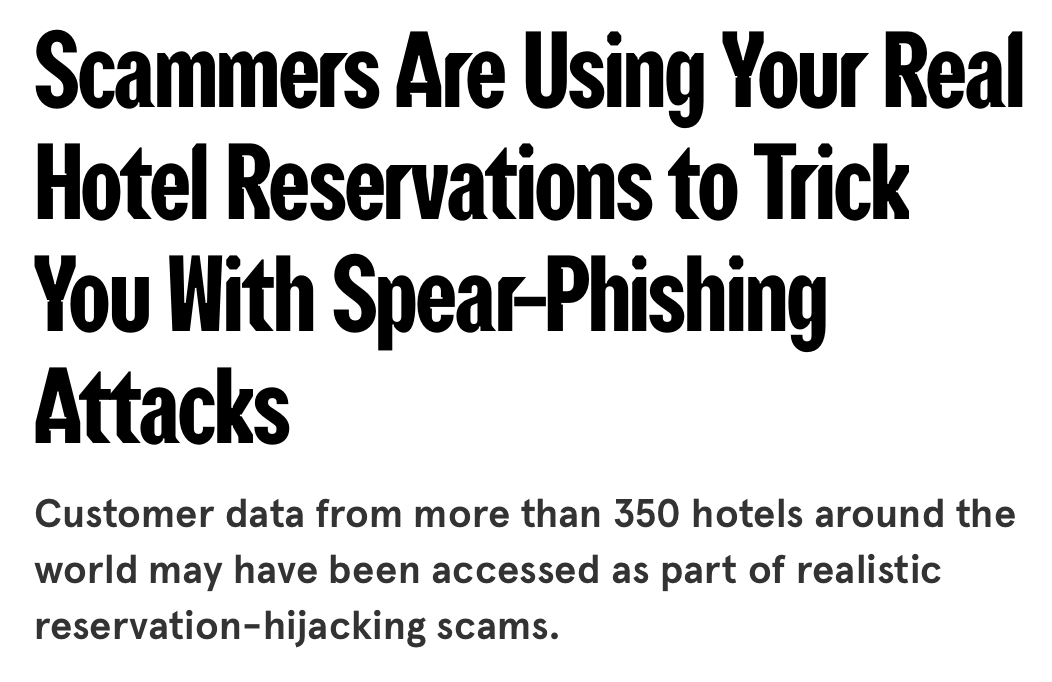
Things, of course, have gotten increasingly blurry. Investigative reporters often go so deep into a specific topic that they uncover scientific truths. On the other hand, researchers often work on projects that amount to a form of academic journalism. That is, they report on a thing that happens with little interest to why it happens or how prevalent it is. In short: journalists report on things happening and academics try to understand how and why things happen and whether they are different from the body of knowledge that already exists.

Why
Understanding a thing allows you to make that thing happen more or less, depending on what outcomes you care about. A journalist may report that young people are voting at lower rates, which is a problem for civic participation. A scientist may have uncovered that young people will vote at higher rates if they see other young people voting on Snapchat. Local governments, caring about civic participation, may then launch campaigns on Snapchat to drive people to the booth.
Knowing how tweaking one variable affects another variable is useful. This is called a causal relationship. Exposure to germs leads to disease. A better diet leads to healthier outcomes. These are things reminiscent of science classes like biology or physics. But they also extend to the Internet. We may uncover that people with more social media time usage have worse mental health outcomes. Or, we may uncover something more specific, such as the fact that higher consumption of short form video content leads to greater levels of anxiety.
Another type of question we care about is how much of a thing is happening. In a more traditional scientific field, this could be something like: "how much CO2 is there in the planet right now? And, how much does this change week over week, or year over year.” This is called a measurement. On the Internet, we may be interested in measuring how much of all Telegram bot activity is illegal. Or, how many illegal drugs are sold over the Internet. In fancier terms, this is measuring the prevalence of a phenomenon. Measuring a thing is useful to know whether we should do something about it.
For what and for whom
Too many reasons to name and too many stakeholders. For example, some medical research is useful so you can develop better treatments so that people suffer less or live longer. These outcomes can be useful, health insurers, pharmaceutical companies, hospitals, politicians, governments, military, society at large, and/or even the researchers themselves. Depending on what the research is, some combination of these groups may want to fund the research.
Internet research is equally complex. The Internet is broad and full of activities. There’s many entities that care about what goes on there. Broadly, though, funding comes from industry (e.g., tech companies), government/military, and others (e.g., weird philanthropic organizations). Meta may want to know how to not give teenagers body dysmorphia through their algorithms. The IRS may want to know how much of all crypto transactions is evading taxes. And, an organization like Open Society may want to reduce antisemitism in online communities.
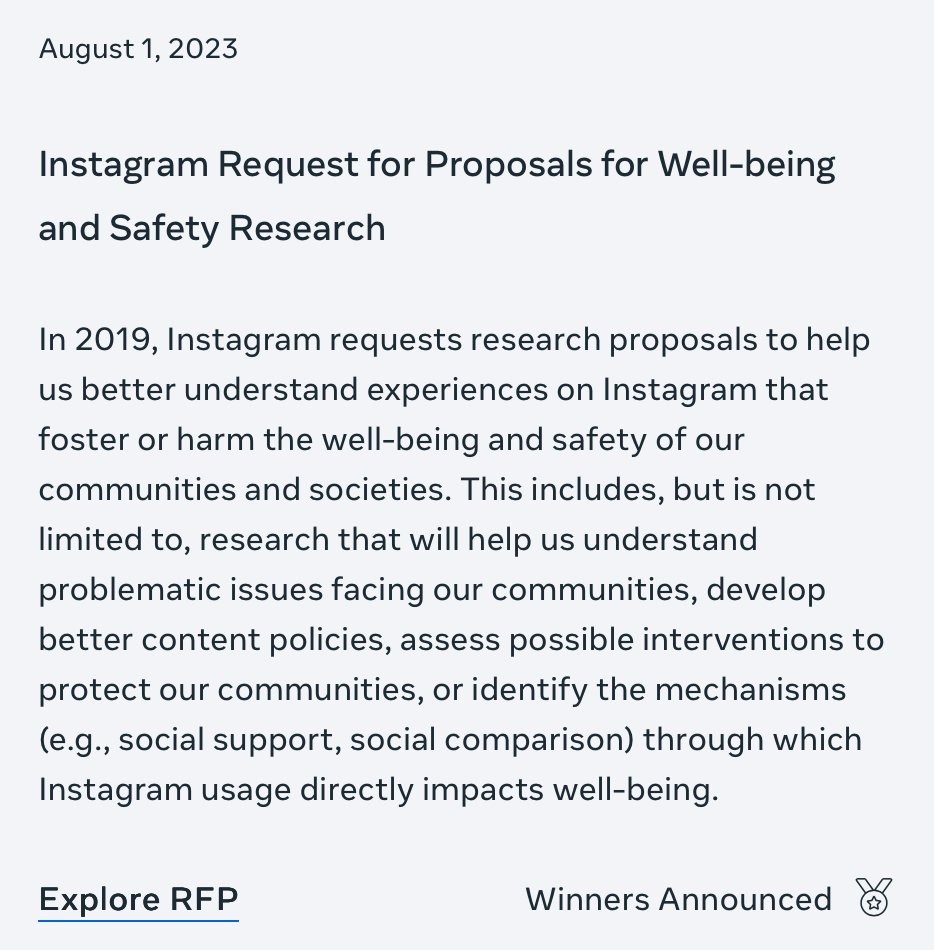
Each of these groups may allocate some amount of funds for causes they care about. Scientists with the expertise write proposals for the work that they want to do. If selected, the scientists receive the money and do the work.
How
Formally, this is the “methodology” question. How do you do science? In the simplest form, how do you figure out that social media use worsens mental health? For the most part, and whenever possible, we apply the same conventional techniques we would apply for “regular science.” If you want to know whether a drug is effective at making your hair grow, you do a randomized controlled trial. You randomly split a group of people, you give the drug to one group, and you give a placebo (e.g., a sugar pill) to the other group. You then measure whether there was meaningful difference in hair length, density, fragility, etc.
With Internet stuff, you would ideally like to do the same. You make one group of people use a lot more social media and the other group you make do something else that counts as a good placebo. You may quickly realize though that things get a little je ne sais quoi TRICKY. Each person’s social media feed is different. Is it comparable across each person? What’s a good placebo? How long should you do this for the effects to take place? How do you measure mental health outcomes? No need to answer these questions here. You just need a taste of what these questions and problems look like.


There’s many techniques we can use to study things. The Internet is a rich medium, full of data, online chatter about myriad topics, plenty of traces of human psyche laying around to be inspected and perused. Like a TV with Animal Planet on, curious academics like myself get to observe peoples’ interactions in the wild.

Here, in the infinite scroll of the digital wetlands, we witness something truly extraordinary. A male has ventured beneath a female’s photograph––that most perilous of territories––and left his mark.
He has chosen three words. This is deliberate. Too many and he appears eager; too few and he risks invisibility among the dozens of identical displays competing for her attention in this very thread.
She has not responded. He has liked his own comment. We watch. We wait. Somewhere, in another tab, he is refreshing.
What am I, myself, currently working on
You have heard me talk a lot about Telegram, deepfake pornography, and vices. Surprise, this is because these are typically the things that I work on. I have studied people faking online influence, online fraud, markets of drugs, hacking forums, cryptocurrencies, scams, DAOs, questionable digital goods, piracy, etc. I am currently trying to figure out what these age verification laws are accomplishing and whether this TAKE IT DOWN Act thing is doing what it is supposed to do. Next up: problematic pornography consumption and what drives that behavior.
Summary
My goal with this publication is to give you an insight on the sketchy things that happen on the Internet. Not only because it is fun and good weekend dinner conversational fodder, but because the things I study are often things that will either affect you directly (e.g., being targeted by a scam) or they will affect you indirectly (e.g., through legislation designed to prevent something). For example, age verification laws are being rolled out around the US and other parts of the world. Soon (if not already), you will need to provide some sort of verification that you are old enough to access certain sites. You may find this troubling, annoying, or both. Knowing why these things exist will probably not make them any less annoying, but you might feel compelled to civically complain about them to some legislator.
This post was a quick overview. Broad vague strokes devoid of specificity. Send me an email if there’s a topic that interests you. Or, even easier, drop a comment. Why not? I might just write the next week’s episode fully based on what you ask for.