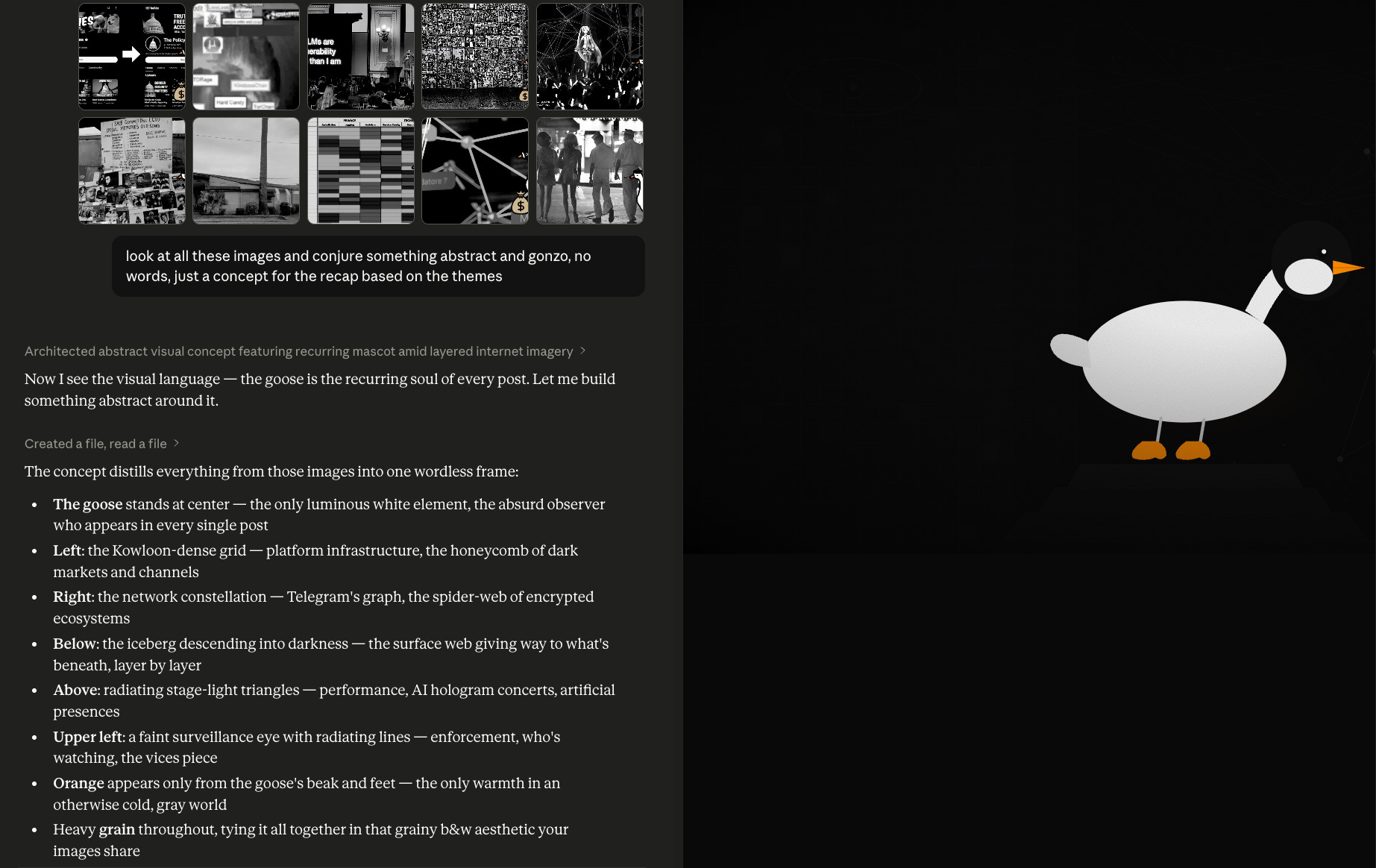

I stared at the flashing cursor on my screen. Empty. No words coming out. I had said one post every Friday. And now, it was Friday yet again. Friday never stops coming.
What do I tell my readers? Will they understand? The pressure, the deadlines…
Complete blockage. Dire constipation of thoughts. No funny openers, no hooks, no attention grabs. I stared at the bottom of the screen for answers: the orange splat is always there for those who come for help. If I prayed the right words it could give me the answers. Some answers at least, or some semblance of answers. The clock continued to tick. My subscribers were waiting.
Would they know? Were they actually reading? Surely, they are not reading each line I write.
I may just be able to sneak this past them, inconspicuous, but dirty. This is just what they do at the Link: artificial words made up in some datacenter somewhere, completely devoid of soul. It’s too early to sacrifice their trust. But is it? A swarm of agents could get me that sponsorship, that affiliate deal. Yes, maybe a few external advisory seats and recurring consulting gigs, expert witness, talking head, pundit. After I close the deal on my new apartment in some metropolitan city paid in hard cold cash directly from Substack HQ. Would I care? Let my agents manage my views and engagement and likes and follows. Passive income.
Certainly, this was all an attractive proposition. But I would have to do so carefully. One wrong move and the jig is up, the whole house of cards would come crashing down. They would uncover my orchestrated scheme of agents designed to maximally extract attention through words like “seedy” and “gonzo” and some secret truth about the Internet’s underbelly that only I knew and no one else. They would tar me and feather me and I would be relegated to a life of fundraising from companies that know no better: a69z, big tree capital, Ychromosome.
No, I must be careful and start with something simple, a summary of sorts…
Hello and happy Friday! It was hard to squeeze some time to write this week because I was working on my first ever journalistic assignment: read my piece––for Tech Policy Press––about the TAKE IT DOWN Act here. Like, comment, share, and subscribe to them if you are interested in, you guessed it, tech policy. Great people over there.
Coincidentally, I’ve been tied up this week working on revisions for the deepfake pornography study which I discuss in the piece above. The deadline is Saturday morning and I only have a few dangerously asinine reviewers’ comments left to tackle. Because of this, and due to the fact that we have just crossed 10 posts, I figured it would be a good time for a recap of everything we have tackled so far.
See you next week!
#001 // The enforcement of vices on the Internet. (Mar 6, 2026)
Drawing on research documenting deepfake pornography services openly listed on Fiverr, the post uses the history of online drug markets as a framework for thinking about how vice enforcement plays out on the internet. Each crackdown tends to push activity to a more fragmented, harder-to-police layer rather than eliminating it. The conclusion: enforcement creates friction but rarely eradication, and the same arc that played out with drugs is likely to repeat with AI-generated nonconsensual imagery.
#003 // The ideologues preserving deepfake porn. (Mar 13, 2026)
Financial levers––cutting off payment processors, defunding platforms––are the go-to enforcement tool for curbing deepfake pornography, and they work on purely money-motivated actors. But a significant subset of the community is ideologically motivated, treating censorship resistance as a value in itself, and will maintain and distribute the tools for free regardless of financial consequences. The post uses the piracy movement as a parallel: ideology, not profit, is what keeps the hardest-to-kill corners of the internet alive.
🏆 Winner: Highest open rate.
#002 // The performance was always the product. (Mar 20, 2026)
AI influencers and fake OnlyFans personas are being treated as a new phenomenon, but “fake” accounts built to sell adult content were already thriving well before generative AI––they just required more human labor. The post traces cases like AyannaSoBlack, an AI-generated persona that went viral, to show that the fraud is less novel than the production cost dropping to near-zero. The real shift AI brings is scale and deniability, not invention.
#004 // The Telegram Ecosystem, Part I. (Mar 27, 2026)
Telegram is not the dark web––it’s something stranger, larger, and far harder to regulate, structured less like a platform and more like a city with no zoning laws. The post breaks down Telegram’s unique architecture (channels, groups, bots, mini-apps) and why it has become the go-to infrastructure for both legitimate communities and underground markets. The sheer scale and permissiveness make it a genuinely novel governance problem.
🏆 Winner: Most views, most likes, most comments.
#005 // AI can now find zero-days. (Apr 3, 2026)
AI researcher Nicholas Carlini demonstrated live that Claude can find zero-day vulnerabilities in major codebases like the Linux kernel, sparking widespread alarm. The post pushes back on the doomsday narrative, arguing the balance between attackers and defenders is more symmetric than people think. For most threat actors, the real bottleneck was never finding vulnerabilities––it was the legal risk of exploiting them.
#006 // The Telegram Ecosystem, Part II. (Apr 10, 2026)
Continuing the series, this installment focuses on the methodological challenge of studying Telegram’s darker corners: advertisements for illicit content don’t equal verified supply, and treating them as equivalent systematically overstates the problem. It draws on the RentAHitman.com analogy––a seemingly alarming site that, on inspection, is mostly bait––to argue that sustained fieldwork is necessary to distinguish scammers from genuine bad actors. The policy implication is that inflated threat estimates lead to poorly calibrated responses.
#007 // The dark web is dying. (Apr 17, 2026)
The dark web (Tor-based hidden services) was once the premier home of illicit online activity, but it has steadily lost ground to more convenient alternatives like Telegram. The post explains how Tor works, traces the evolution of dark web markets from their early days through repeated law enforcement takedowns, and argues that inconvenience––not policing––is what’s truly killing it. The underground didn’t disappear; it just moved somewhere easier to use.
#008 // Chameleon Channels. (Apr 24, 2026)
Social media accounts are a valuable commodity with a booming underground economy of buying, selling, and repurposing them––sometimes pivoting overnight from, say, a COVID vaccine info account to a partisan political outlet. The post explores how platforms are poorly equipped to handle this identity-switching, since followers have no say when an account they trusted transforms into something entirely different. The underlying driver is simple economics: captured audiences are worth real money.
#009 // Do you need a VPN? (May 1, 2026)
Commercial VPNs do exactly one thing: route your traffic through their servers so intermediaries can’t see what you’re browsing, which also lets you spoof your location. The post warns against the affiliate-link-poisoned “best VPN” comparison guides littering the internet, recommending Mullvad for genuine privacy needs, iCloud Private Relay for Apple users, and Tor for anyone who wants true anonymity. Free VPNs are a hard no––their only viable business model is selling your data.
#010 // The takedown scam (May 8, 2026)
The post recounts receiving a suspiciously formal DMCA takedown notice at Redoux (the author’s fragrance brand), demanding a backlink credit to “Ice Baths Australia” under threat of legal action––complete with a fabricated law firm and fake lawyer. Investigation revealed it was an SEO scam: bad actors send fake copyright notices to small website owners who, out of fear, comply and add the requested backlink, boosting the scammer’s search ranking. It’s a clever, low-risk exploit of how few people actually know DMCA procedures or bother to verify the sender.
???